
Ponce, Puerto Rico—affectionately known as La Perla del Sur (The Pearl of the South)—is a city that defies the typical Caribbean stereotype of “just another beach town.” Founded in 1692, it stands as a testament to the island’s grander, more aristocratic past. While San Juan is the bustling capital, Ponce is the refined cultural soul, characterized by its unique “Ponce Creole” architecture, world-class art, and a history as rich as the coffee grown in its surrounding mountains.
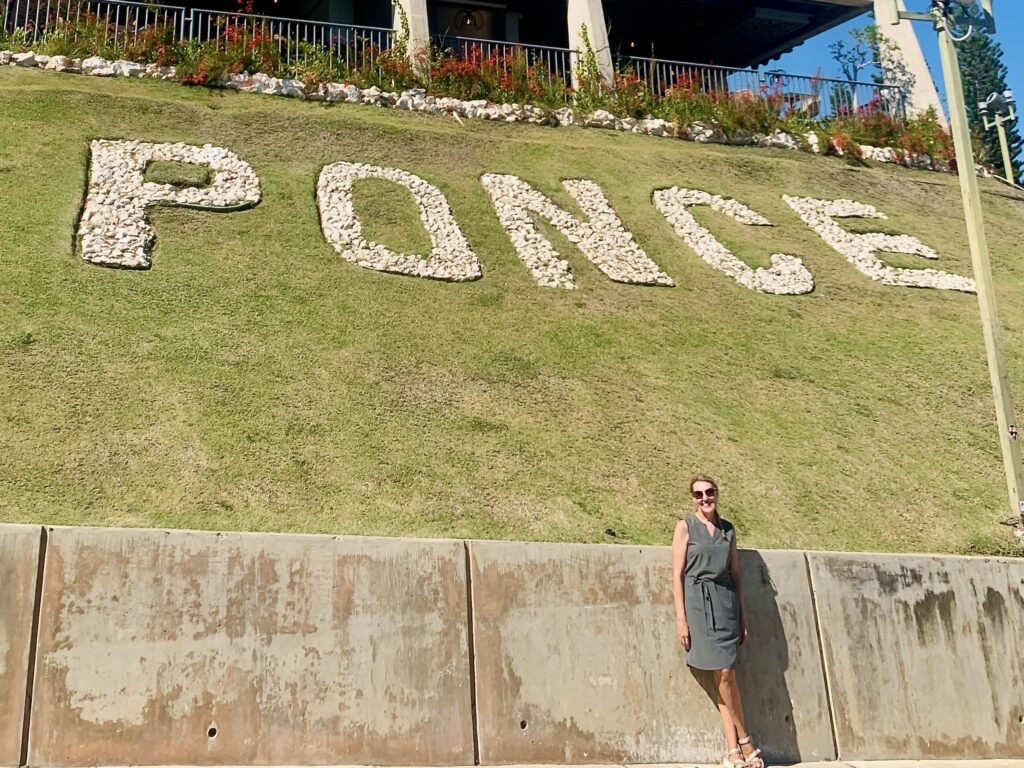
We were here for almost a month, and we got to know our way around pretty well.
Things We Loved Most About Ponce, Puerto Rico
1. Plaza Las Delicias
Plaza Las Delicias serves as the vibrant urban heart of Ponce, Puerto Rico, and is widely considered one of the most beautiful town squares in the Caribbean. Uniquely designed as two contiguous plazas—Plaza Muñoz Rivera to the north and Plaza Degetau to the south—it is a perfect example of colonial and Neoclassical architecture.
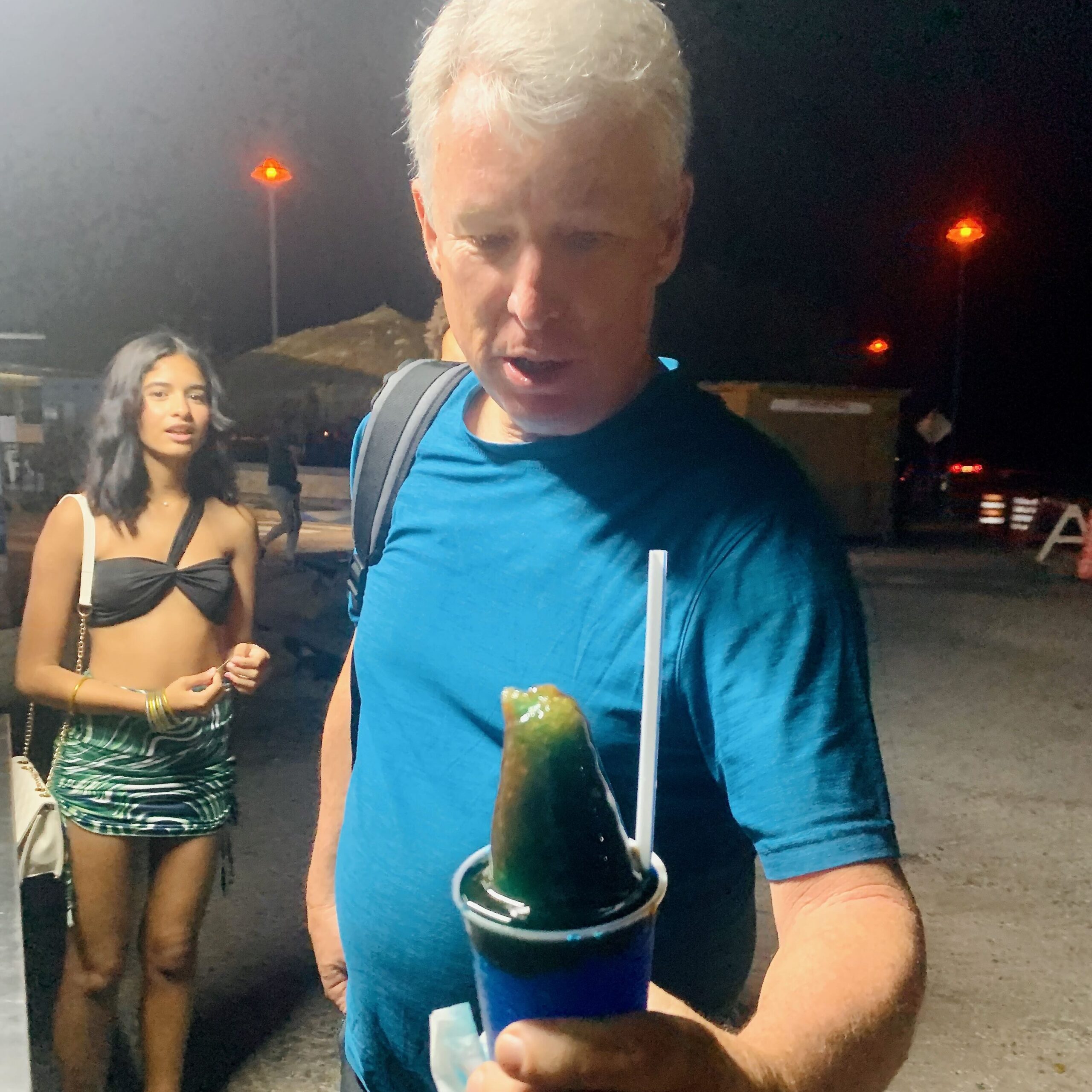
Lined with towering Indian laurel trees and historic buildings, the plaza is a hub of local life. The plaza comes alive at night with vendors selling piraguas (shaved ice) and local artisans displaying their crafts.
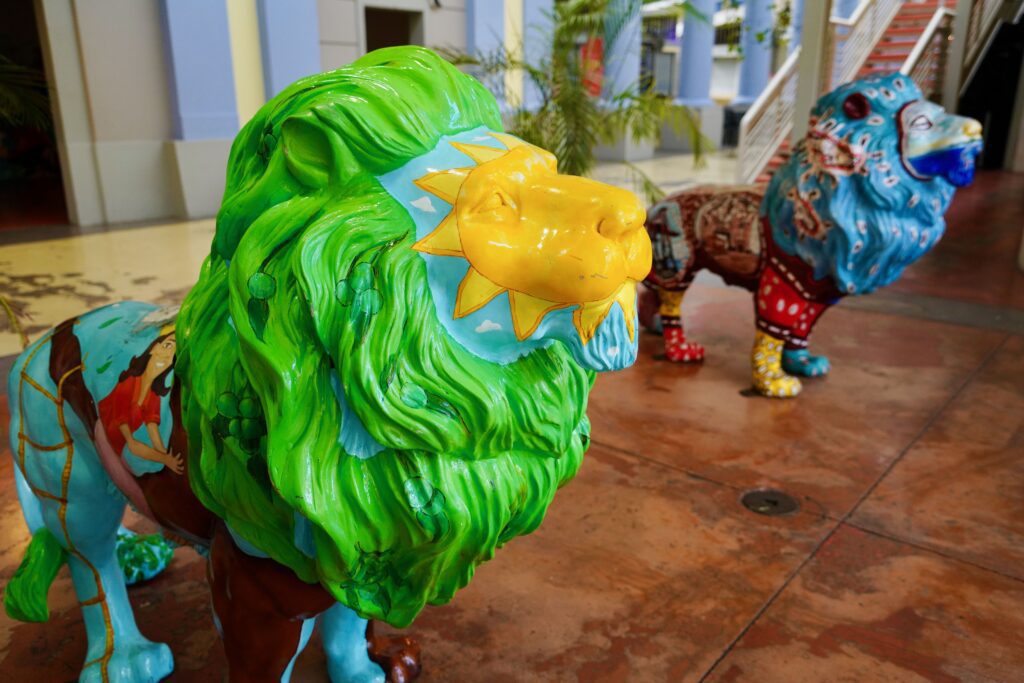
Fuente de los Leones (Lions Fountain)
In the center of the plaza sits the Lions Fountain. Ponce is often called the “City of Lions” (after Juan Ponce de León), and these bronze statues symbolize civic pride. The fountain is iconic and is most dramatic at night.

Catedral de Nuestra Señora de Guadalupe
Located at the heart of Ponce, Puerto Rico, the Catedral de Nuestra Señora de Guadalupe is a historic landmark with roots dating back to 1670. It occupies a central position in the plaza. The current structure, characterized by its elegant neoclassical facade, primarily dates from a 1930s reconstruction following the devastating 1918 earthquake. Its exterior is painted in soft blue and gray tones, featuring two three-story square towers topped with silver-colored domes.

The interior follows a traditional cruciform plan with a large central dome and is noted for its blend of colonial and Gothic styles. Inside, visitors can find a grand pipe organ—historically played by the renowned danza composer Juan Morel Campos—and vibrant stained-glass windows depicting religious scenes. Beyond its architectural significance, the cathedral serves as the seat of the Roman Catholic Diocese of Ponce. It was listed on the National Register of Historic Places in 1985 and remains a centerpiece of the city’s cultural heritage, especially during the annual “Las Mañanitas” procession held every December.

Parque de Bombas
The most photographed building in Puerto Rico is undoubtedly the Parque de Bombas. This bold, red-and-black striped wooden structure was originally built as a pavilion for an 1882 exhibition and served as the city’s main fire station for over a century.

Today, it is a free museum. Inside, you can view vintage firefighting equipment and learn about the “Heroes of El Polvorín,” the firemen who saved the city from a massive ammunition depot explosion in 1899. Unfortunately, it was closed when we were there.
Other Things We Saw in Plaza Las Delicias


Click unmute for the full experience:

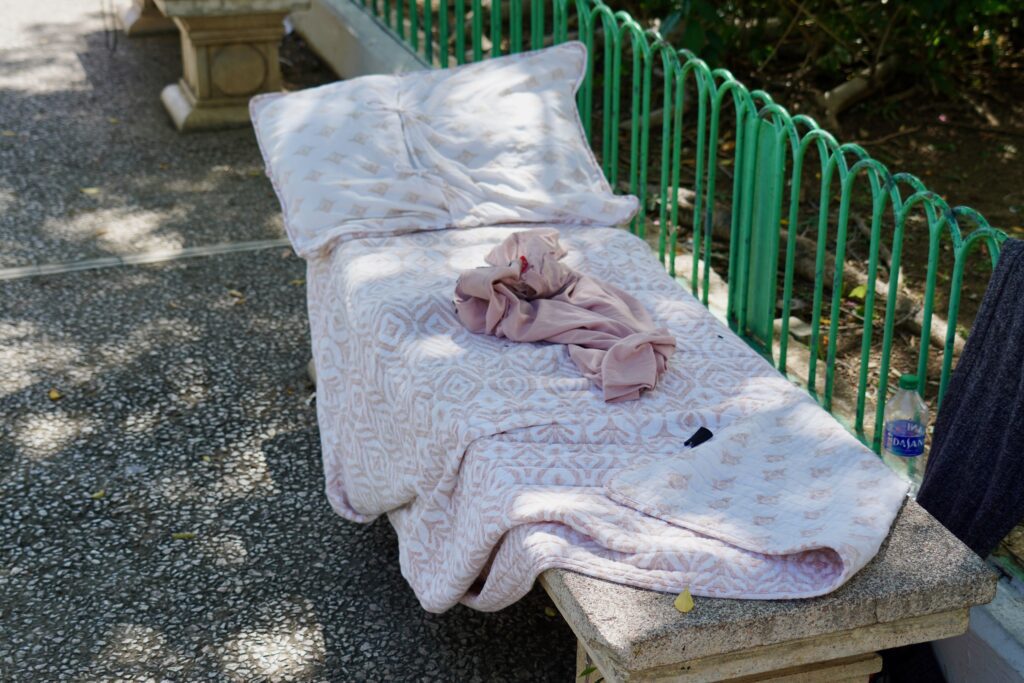
And then this. Heartbreaking.
2. Sundays in Ponce
Puerto Ricans love their Sundays. Everything shuts down, and the locals come out to celebrate.
Click unmute for the full experience.
3. La Guancha Boardwalk
Because of its proximity to our anchorage, we came here often.
While staying in the Ponce Harbor Northeast anchorage, we used the Ponce Yacht & Fishing Club as our dinghy dock. The employees there were very understanding, so we made sure to patronize their restaurant/bar frequently in return. The one caveat is that if you do this, you have to hop the fence to get back in when the restaurant closes. To us, that was well worth it.
Now on to the famous boardwalk. Located on the southern coast of Puerto Rico, the La Guancha Boardwalk (Paseo Tablado La Guancha) is a premier social and cultural hub in Ponce. Inaugurated in the early 1990s, the boardwalk faces the Caribbean Sea and serves as a vital recreational complex for both locals and tourists. It is traditionally known for its “kioskos”—open-air eateries and bars serving authentic Puerto Rican street food like alcapurrias and bacalaítos. The pier area is a major focal point, where visitors often gather to feed large schools of Atlantic tarpon and observe Caribbean brown pelicans.
Historically, the complex has featured an observation tower, a playground, and an open-air stage for live salsa and tropical music performances. Although the boardwalk suffered significant structural damage during the 2020 earthquakes, it remains a symbol of Ponce’s coastal identity. While reconstruction efforts continue to restore the original wooden planking to full integrity, the area remains a hub for vibrant community gatherings.
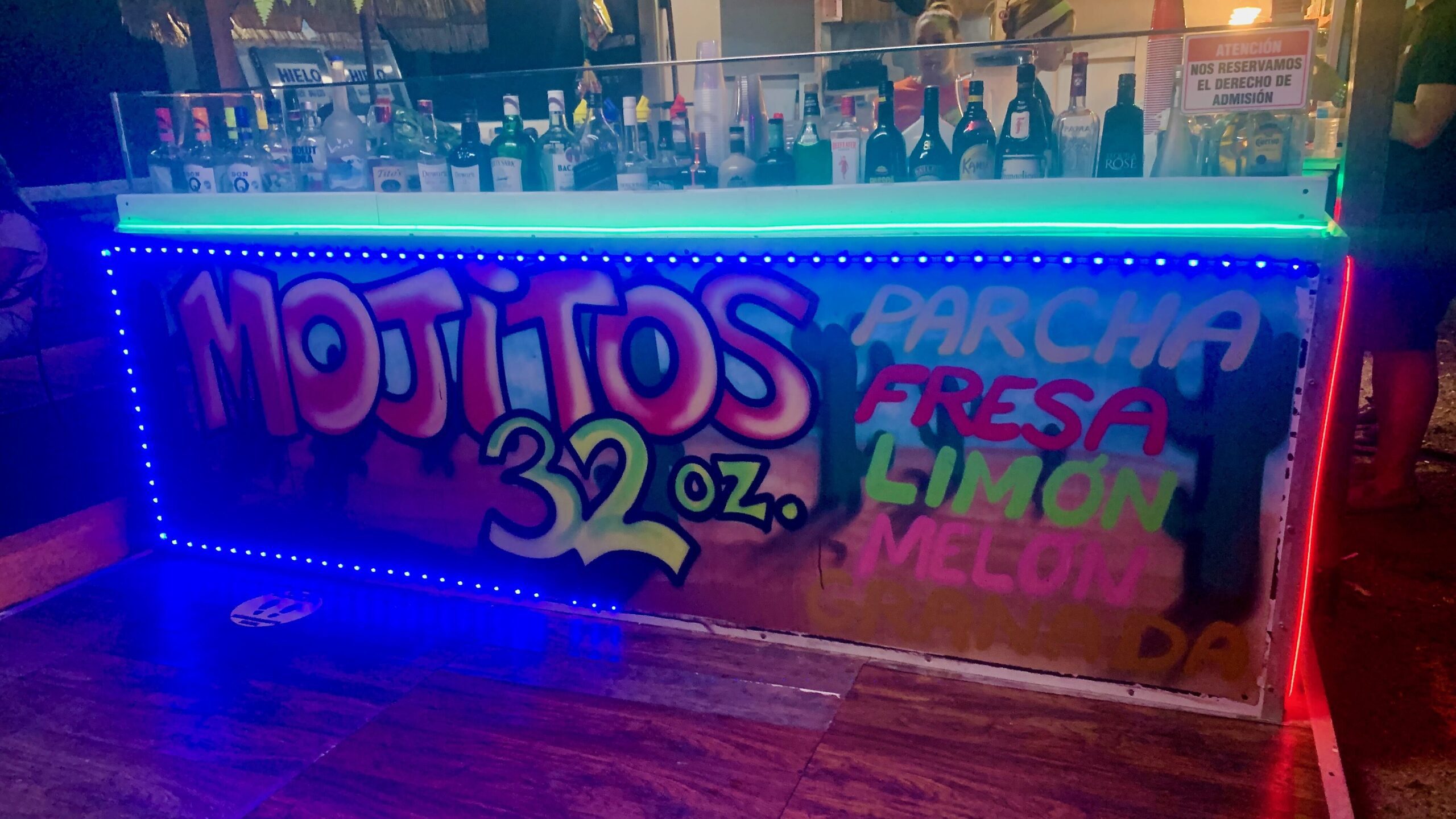
It had temporarily relocated when we were there, but it was still pretty busy on the weekends.

4. Playa Princess Caitlyn
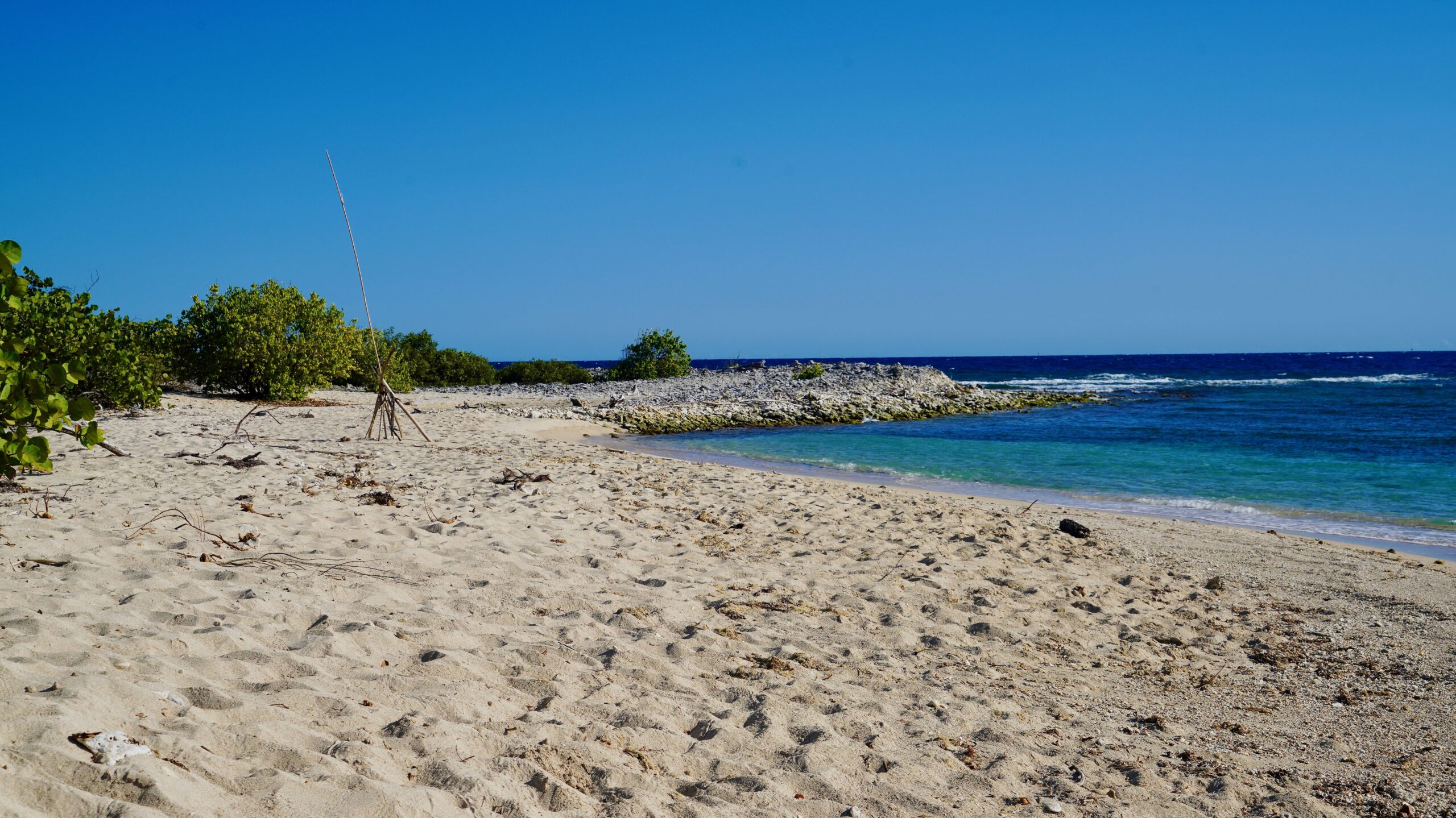
We experienced this beach and fishing pier whenever we walked to the Hilton. It was nice.
5. Castillo Serrallés
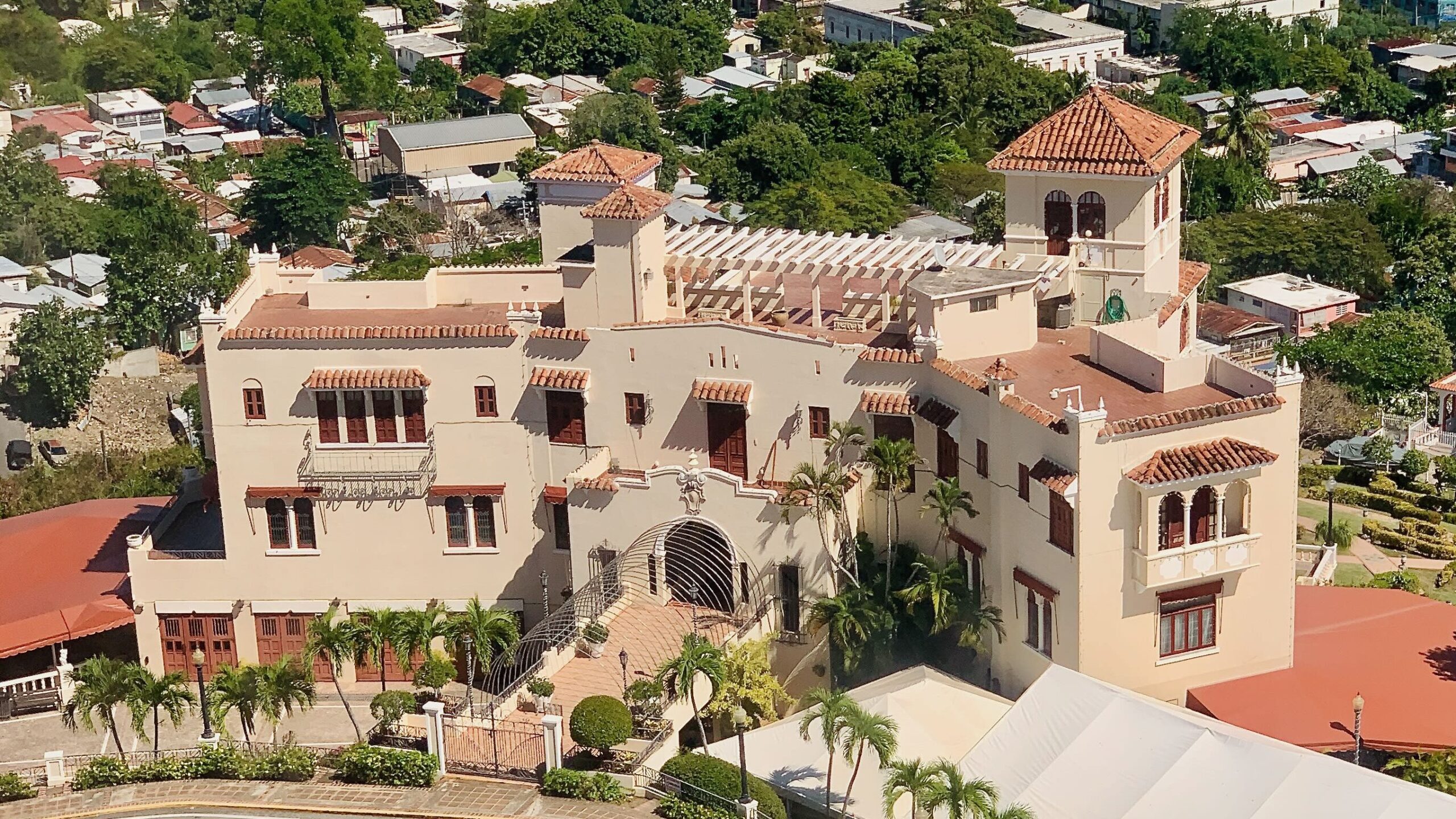
The Castillo Serrallés is a magnificent four-story mansion and museum located on El Vigía Hill, overlooking the city of Ponce, Puerto Rico. Completed in 1930, the estate was designed by architect Pedro Adolfo de Castro for Juan Eugenio Serrallés, the heir to the Don Q rum fortune and the Destilería Serrallés. The structure is a premier example of Spanish Moroccan (Spanish Revival) architecture, characterized by its symmetrical layout, red-tiled roof, interior courtyards, and ornate horseshoe arches. Its construction marked a period of immense wealth for the island’s “sugar barons,” reflecting the industrial success of the local sugarcane and rum industries during the early 20th century.
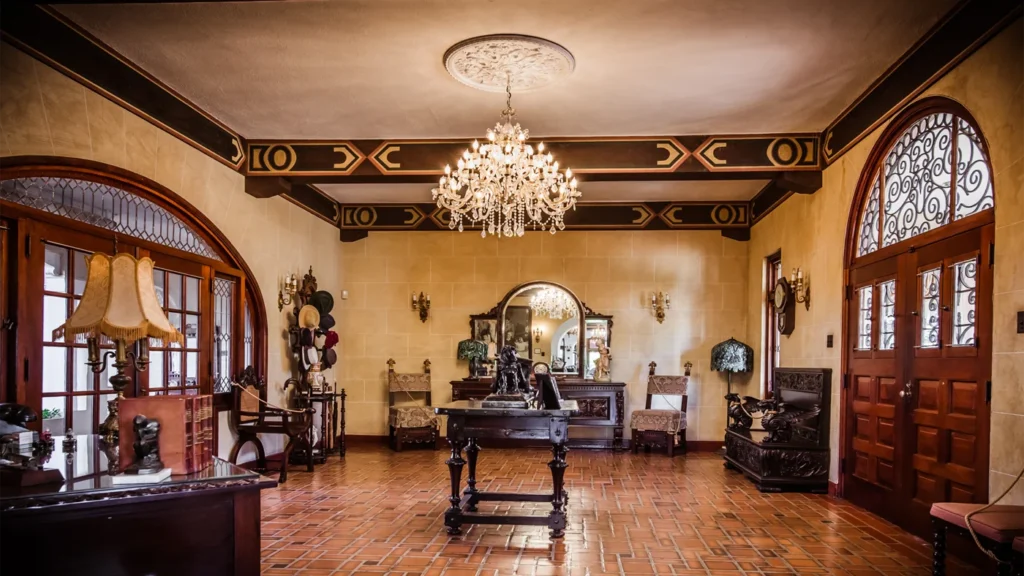
Inside, the mansion serves as a museum dedicated to the history of Puerto Rico’s sugar and rum industries, featuring original period furniture and detailed exhibits on the Serrallés family legacy. The exterior is equally renowned for its meticulously landscaped formal gardens, which include a butterfly nursery and a Japanese-themed garden. In 1980, the structure was listed on the National Register of Historic Places and later acquired by the municipal government for preservation as a cultural landmark. Today, it remains one of the most visited sites in Ponce, offering a window into the opulent lifestyle of the Puerto Rican aristocracy.
We met our friends Bonnie and Jim from s/v Gone Again here, a wonderful bonus.
6. Cruceta del Vigía
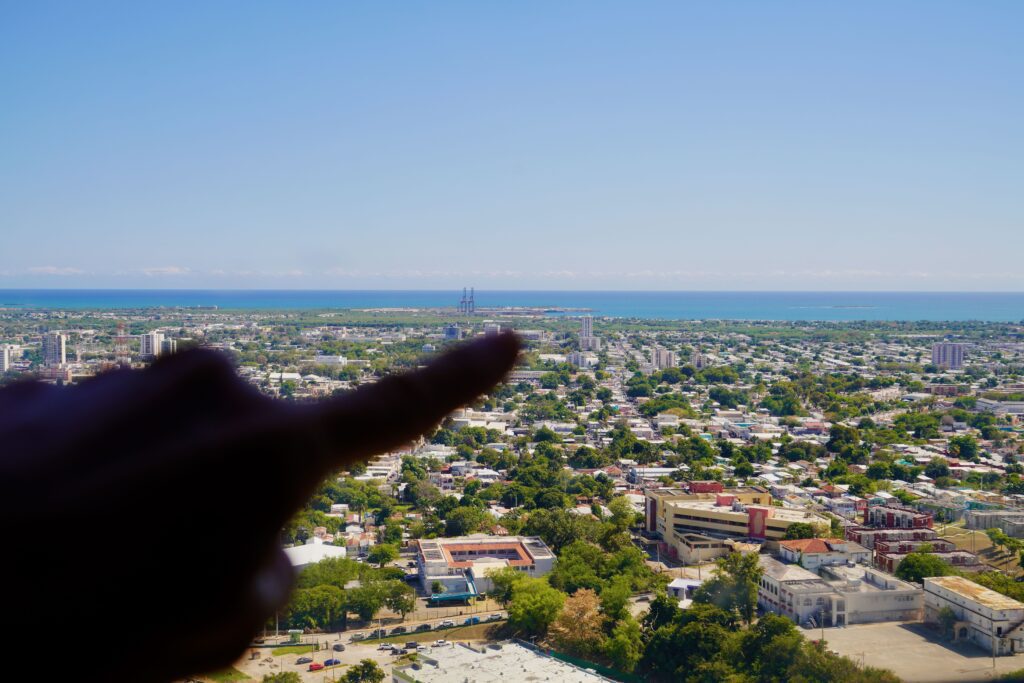
The Cruceta del Vigía (Watchman’s Cross) is a monumental 100-foot-tall reinforced concrete structure situated atop El Vigía Hill in Ponce, Puerto Rico. Erected in the 1980s, the cross marks a site that has served as a strategic observation point since the 1800s. From this elevation of approximately 300 feet above sea level, early watchmen monitored the Caribbean Sea to identify incoming merchant ships or potential pirate threats, signaling the city below with a system of colored flags. The modern structure features a horizontal transverse arm measuring 70 feet in length, housing a glass-enclosed observation deck accessible via an internal elevator.
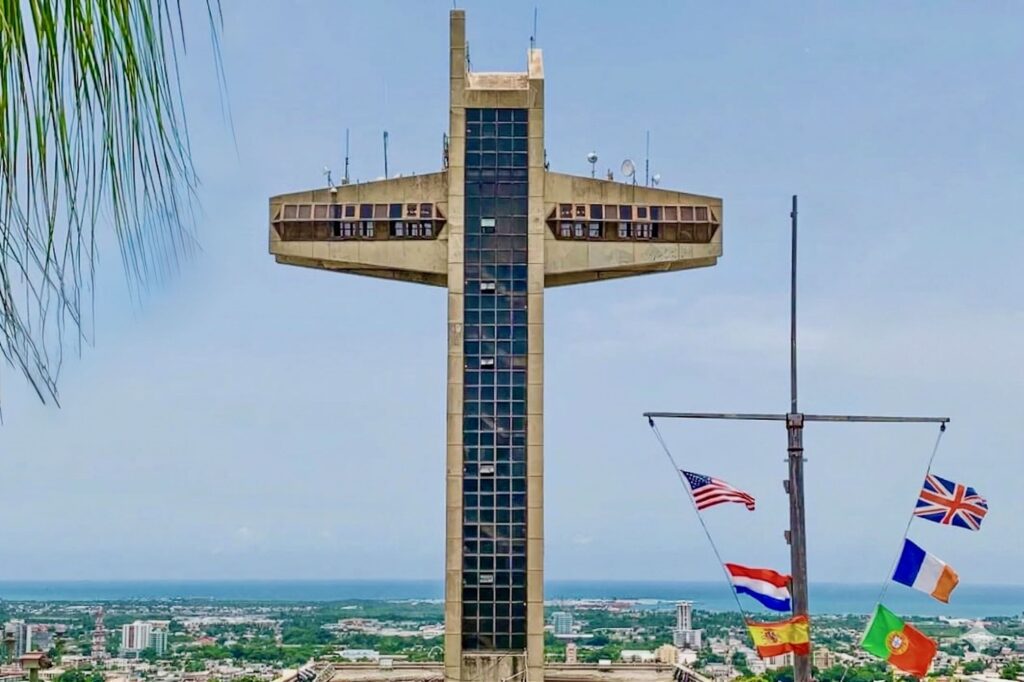
Managed by the Patronato de Castillo Serrallés, the Cruceta remains a symbol of Ponce’s vigilance and maritime history, standing as one of the most recognizable landmarks on the city’s skyline.
Next to it sits a peaceful Japanese Garden, perfect for a quiet stroll after visiting the Serrallés mansion.

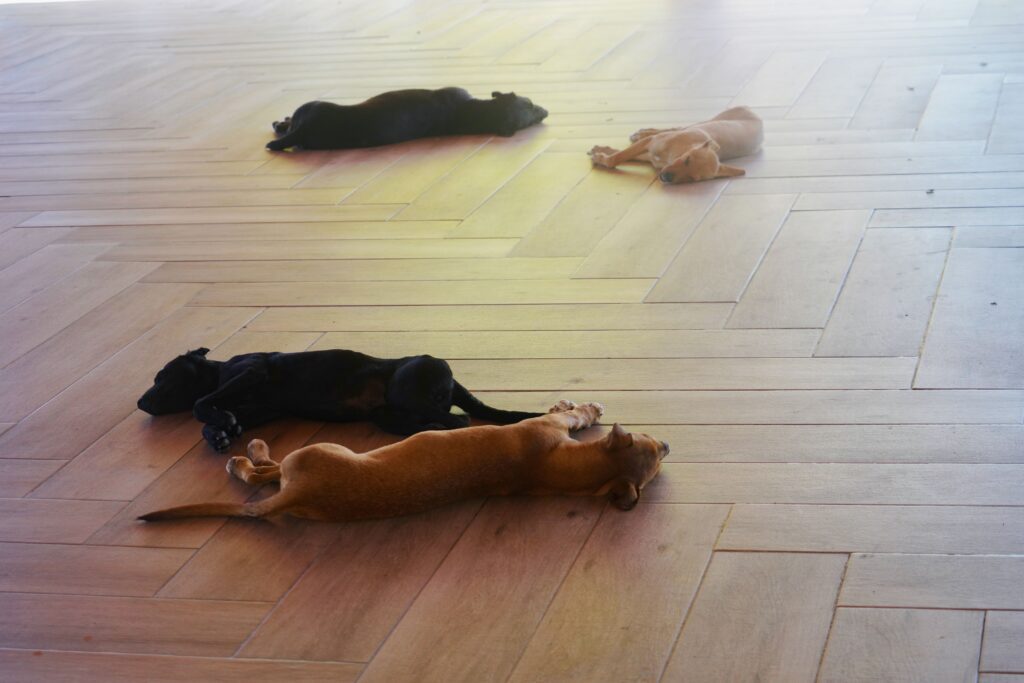
It has a pavilion that serves as welcome shade for local strays.
7. Paseo de los Artistas
The Paseo de los Artistas (Artists’ Promenade) is a vibrant cultural corridor in the heart of Ponce, Puerto Rico, located along Calle Cristina. This pedestrian-friendly walkway was designed to celebrate the city’s rich artistic heritage and serves as an open-air gallery and tribute to the local creators who have shaped “La Perla del Sur.” The promenade is most notable for its series of commemorative plaques and busts that honor distinguished figures in Puerto Rican music, literature, and the fine arts, including world-renowned composers and performers associated with the city’s neoclassical and tropical traditions.
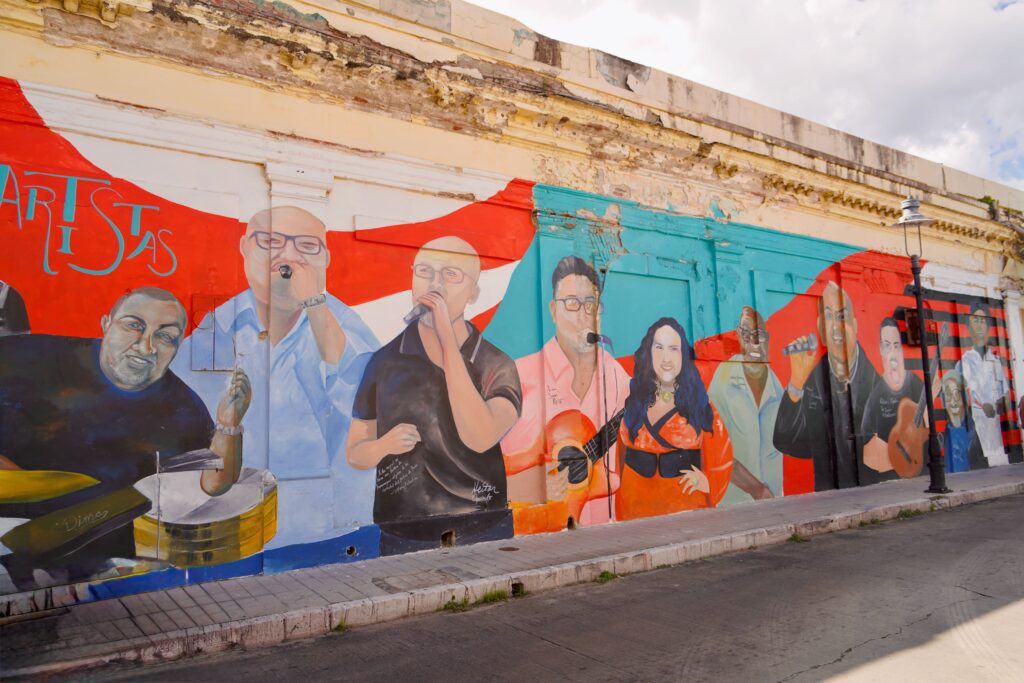
The aesthetic of the Paseo is defined by its traditional Spanish colonial architecture, paved walkways, and proximity to major landmarks such as the Teatro La Perla and the Museo de la Historia de Ponce.

It functions not only as a historical site but also as a contemporary venue for artisanal fairs, live “Plena” music performances, and community workshops. By integrating public art into the urban landscape, the Paseo de los Artistas reinforces Ponce’s status as the cultural capital of Puerto Rico. Visitors can enjoy the juxtaposition of 19th-century elegance with modern creative expressions, making it an essential stop for anyone exploring the city’s refined “Ponceno” identity.
8. Isla Caja de Muertos (Coffin Island)
A short boat ride from Ponce takes you to Caja de Muertos (Coffin Island). This 0.59-square-mile nature reserve is located approximately 4.8 nautical miles south of the city. Its morbid moniker is most frequently attributed to its physical profile, which resembles a person lying in repose when viewed from the mainland.

We easily dinghied there from our anchorage.
The Caja de Muertos Light (Faro de la Isla de Caja de Muertos) is an architecturally significant lighthouse located on the highest peak of Coffin Island. Completed in 1887 by the Spanish government, it was part of a major maritime illumination plan designed to secure the island’s southern shipping lanes. The structure is characterized by its unique “T” shape, featuring a stone-masonry dwelling for the keepers and a central cylindrical tower that rises to a focal height of 297 feet above sea level.
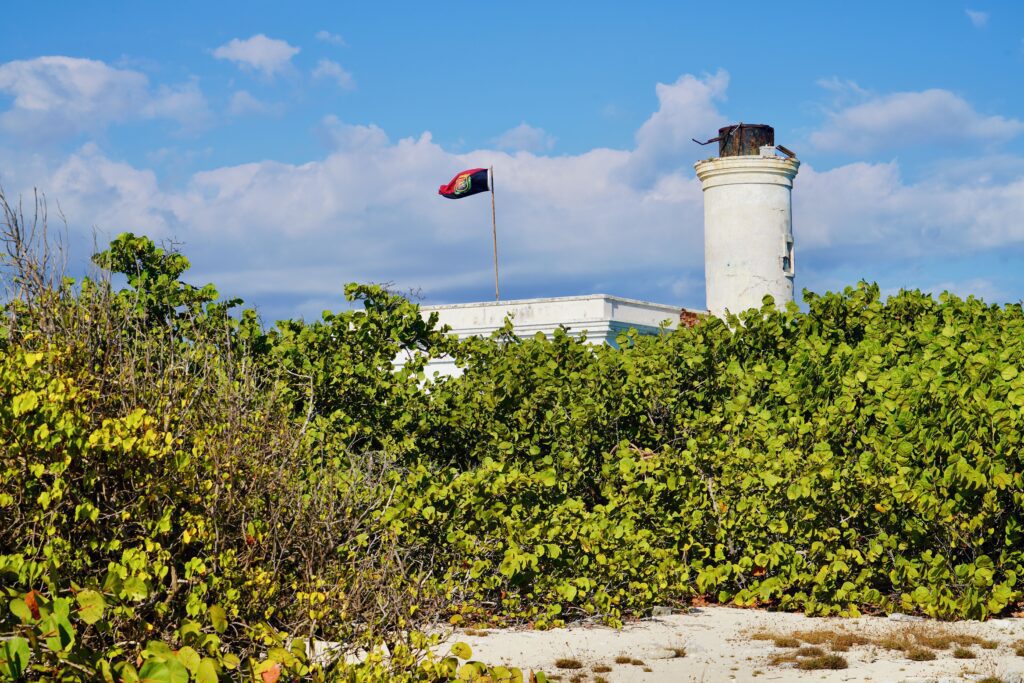
Originally equipped with a third-order Fresnel lens, the light provided a white flash visible for up to 18 nautical miles across the Caribbean Sea. The lighthouse was automated by the United States Coast Guard in 1945. In 1981, it was officially listed on the National Register of Historic Places due to its neoclassical design and historical role in Caribbean commerce.


The interior is closed to the public due to structural deterioration and hurricane damage, but the exterior remains a popular hiking destination.
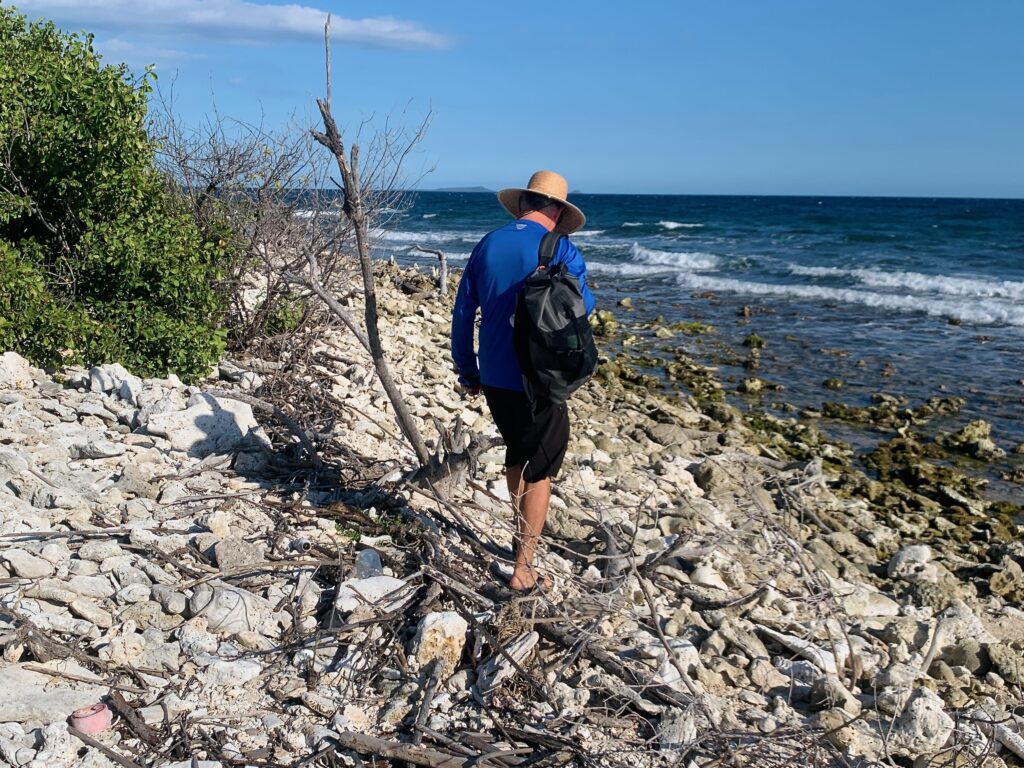
We walked all around the island.
Tip: Wear protective shoes: the beach is covered in coral.
Historically, the island served as a strategic hideout for pirates, a secret meeting ground for 19th-century Freemasons evading Spanish persecution, and a refuge for leaders of the Puerto Rican independence movement.
Designated as a protected reserve in 1980, the island is an ecological sanctuary featuring a rare subtropical dry forest, mangroves, and critical nesting grounds for endangered sea turtles. It is home to unique fauna, such as the Puerto Rican blue-tailed ameiva. Once a bustling day-trip destination famous for the Blue Flag-certified Pelicano Beach, the area has suffered damage from recent seismic activity and hurricanes, resulting in intermittent closures and limited access. Today, it remains uninhabited.

We spent quite a while relaxing and watching this crab.

It industriously used its pincers to load sticks into its mouth and then carried them down to its nest.


At one point, the crab felt around our GoPro stand to see if it could bring it into its nest. It didn’t pass the test.

There was also a memorial on the island. The chair on the left is probably there to allow you to sit and reflect.

Other Memories of Ponce
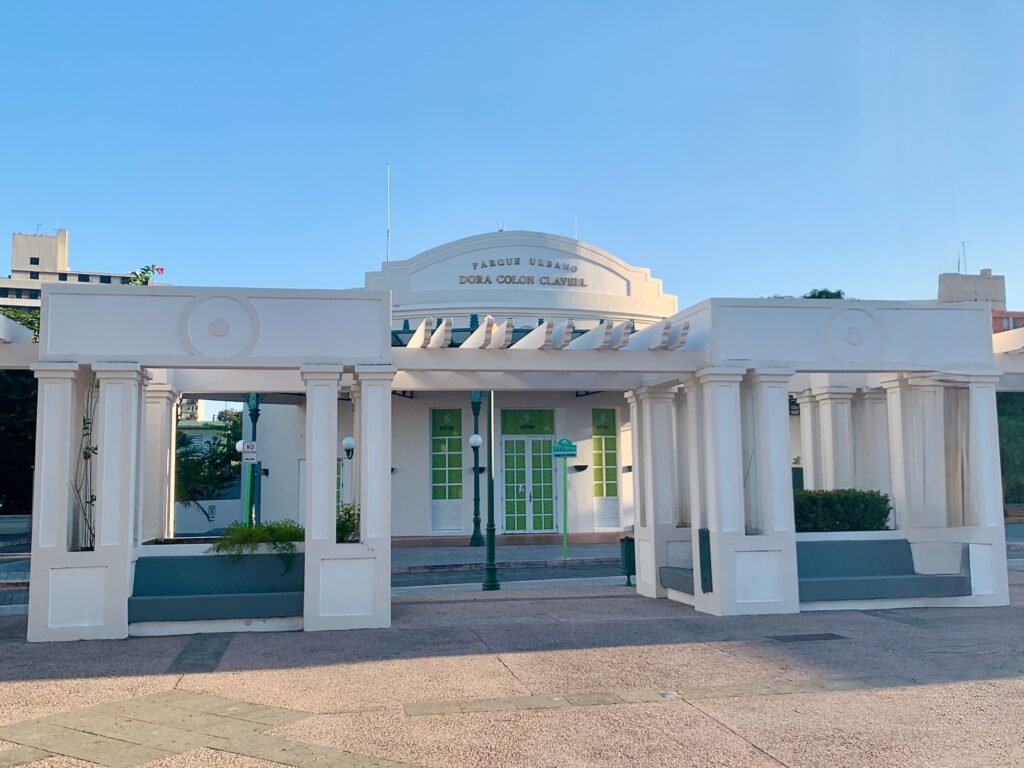
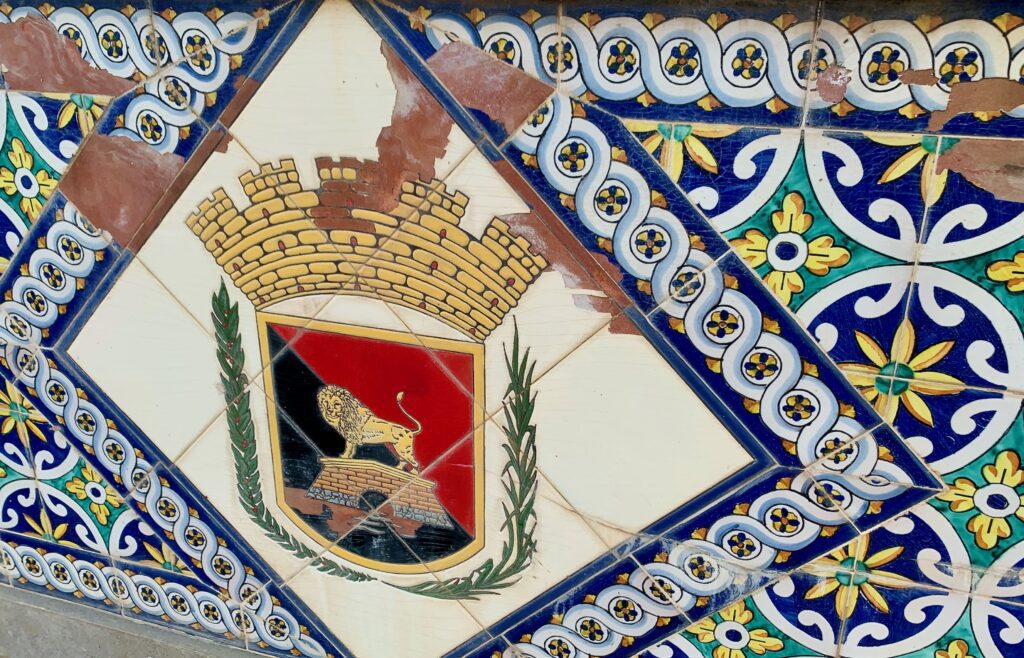
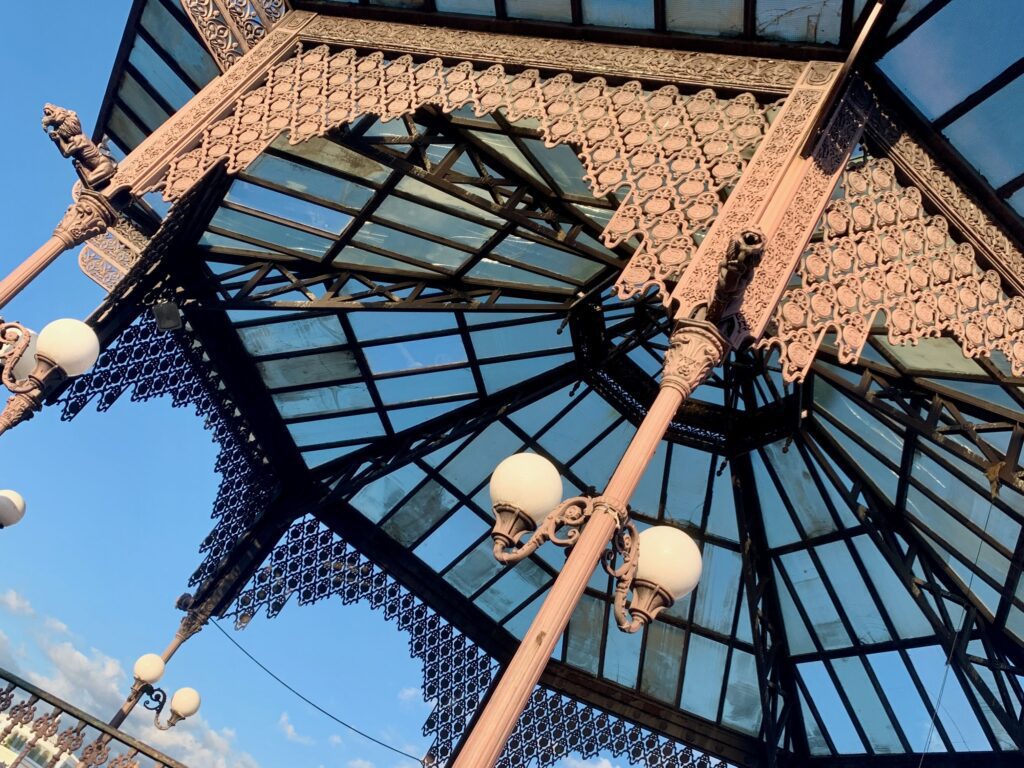
This plaza gets an honorable mention. It was very peaceful.
Other Things to Do in Ponce, Puerto Rico
Hacienda Buena Vista
Museo de Arte de Ponce
Museo de la Historia de Ponce
Museo de la Masacre de Ponce
Centro Ceremonial Indígena de Tibes
Where We Ate
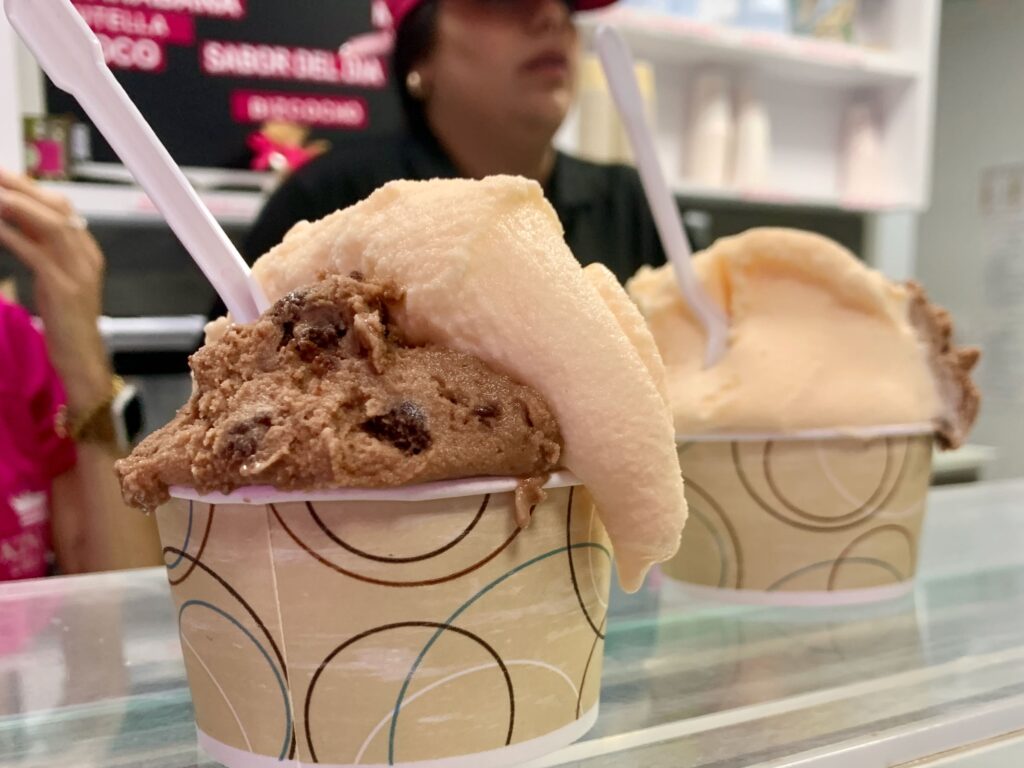
King’s Ice Cream
Located directly across from Parque de Bombas, this institution has been serving locals for decades. There was always a line, so we had to try it.
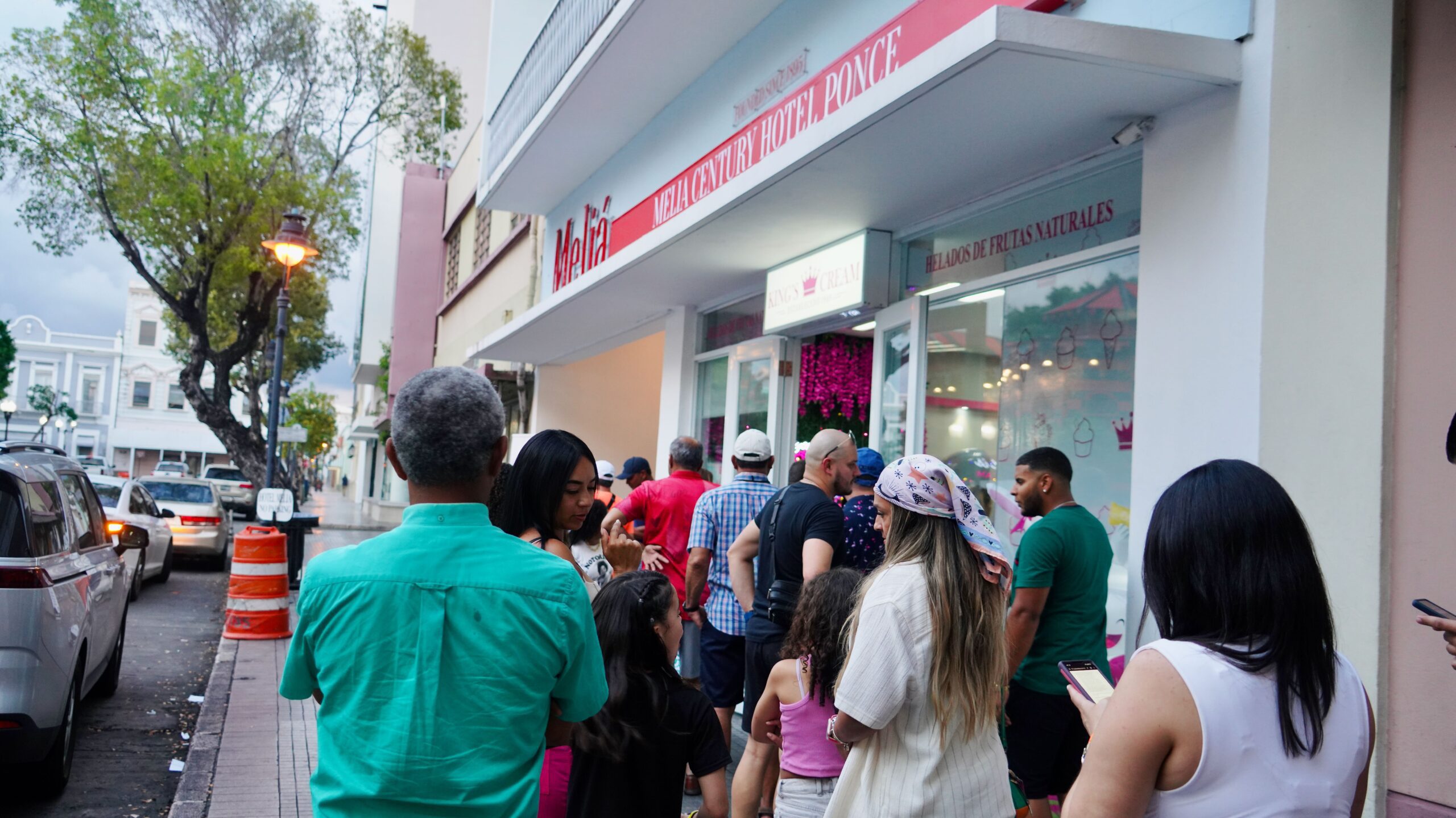
It definitely lived up to the hype!
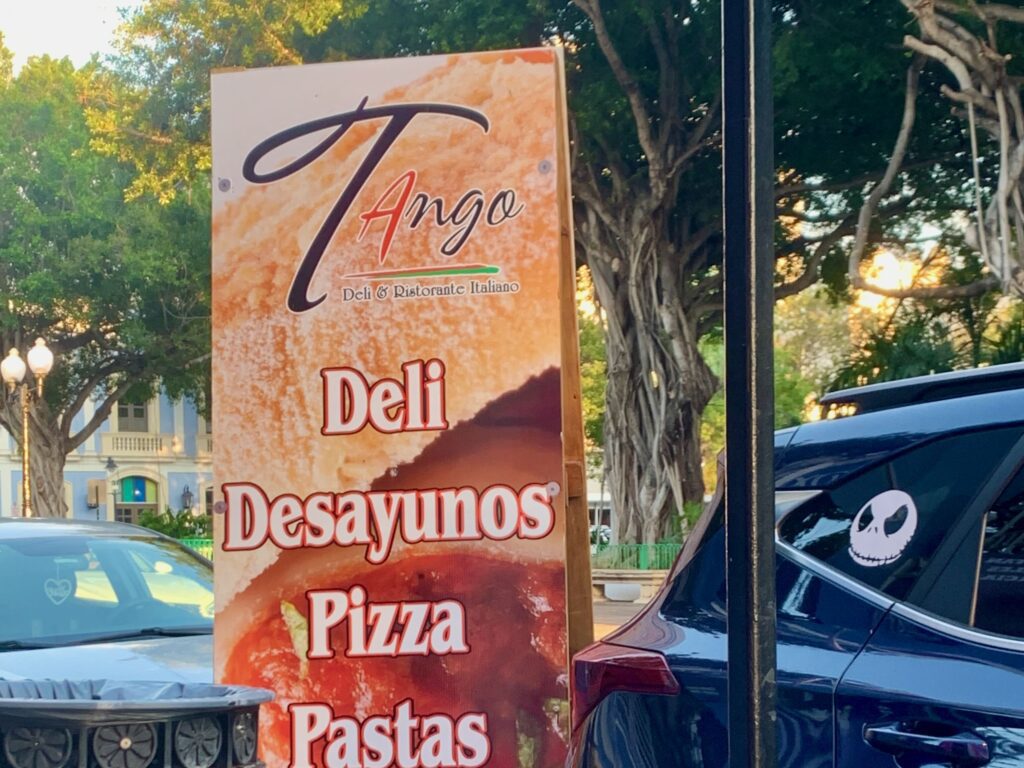
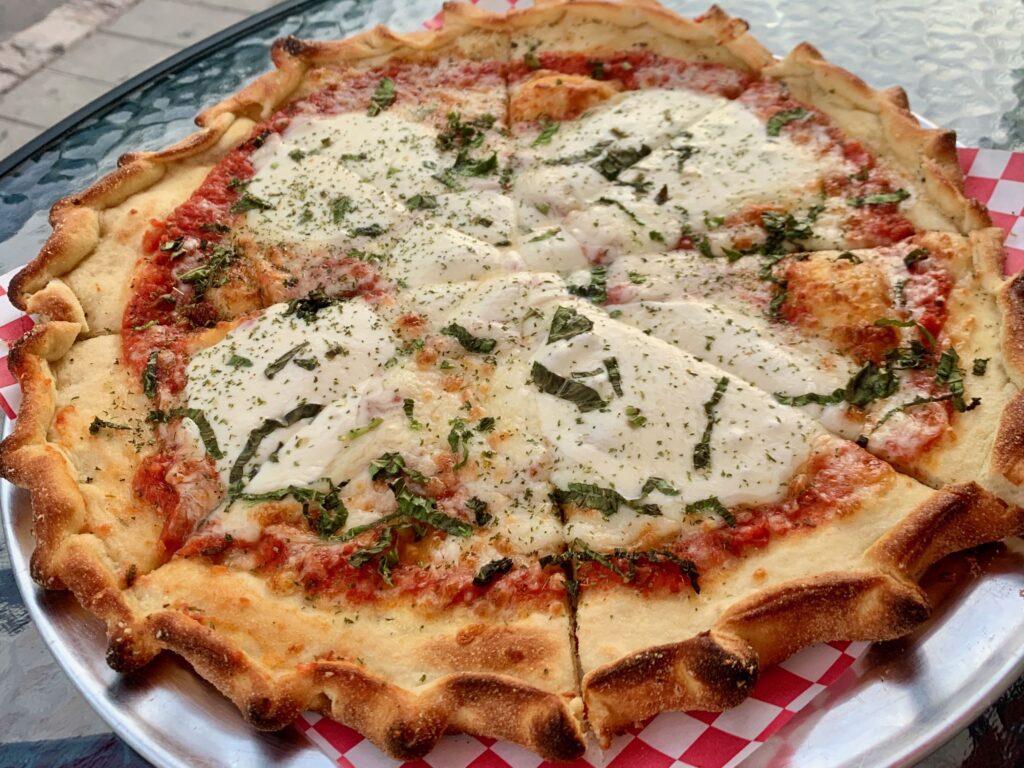
Tango Deli & Ristorante Italiano
Located right on Plaza Las Delicias, this restaurant served up some pretty decent pizza. I’m not sure if it’s there anymore.
Papa Rupe Brewing Co.
We went there for hamburger sliders and a sampling of local craft beers. It was nice and had a great local vibe.

Pizza Hut
We love pizza. Ordering Pizza Hut for delivery near our anchorage was not unusual on its own, but we did get a kick out of ordering pizza “with ketchup.“

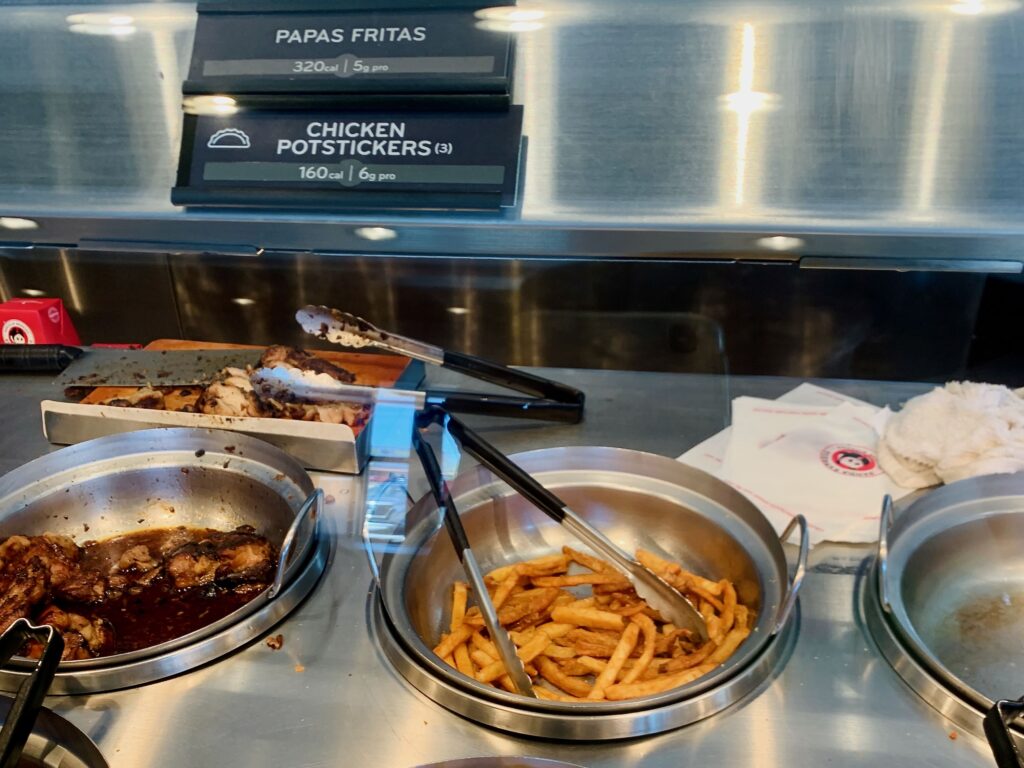
Panda Express
I’m a Chinese food addict, so I was excited to see a Panda Express. What’s unusual here, though, is that they serve French fries.
Shopping
Plaza del Mercado Isabel Segunda
Plaza del Mercado Isabel Segunda (Plaza del Mercado de Ponce) was modeled after the famous Les Halles market in Paris. At the time of its completion in 1863, it was considered the largest and most modern marketplace in Puerto Rico.

The building occupies a full city block in the Ponce Historic Zone and is an architectural hybrid. Its original 19th-century neoclassical bones are now encased in a striking Art Deco facade, a result of a 1941 remodeling by architect Pedro Méndez Mercado. The interior still preserves much of its original structure, including an impressive iron roof system imported from Manchester, England.

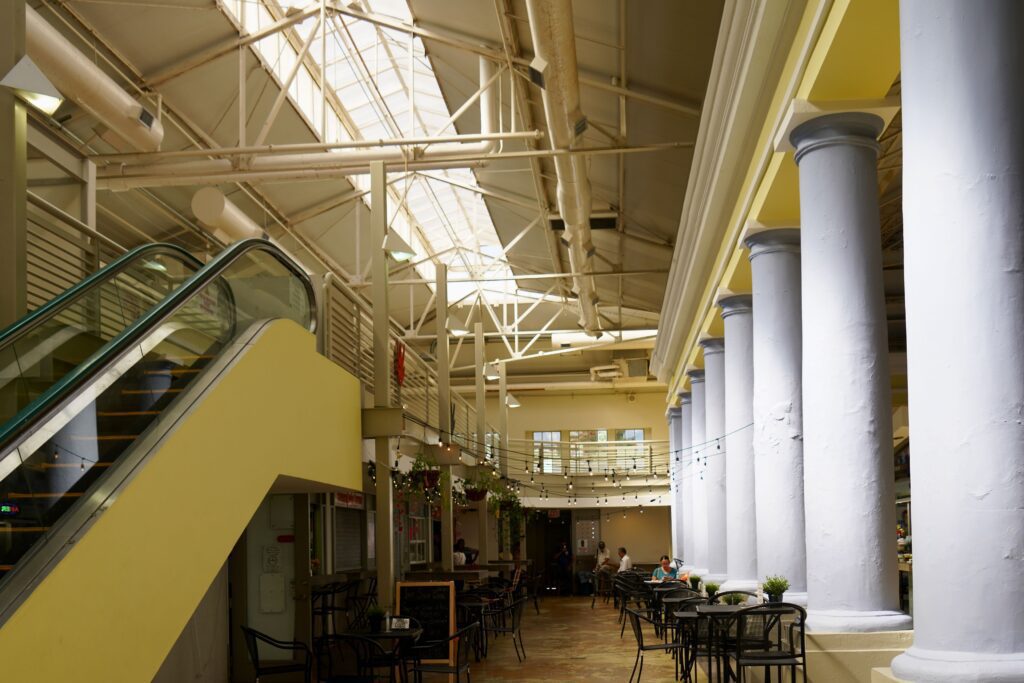
Historically a vital hub for fresh produce and meat, the plaza today features approximately 65 kiosks offering traditional Puerto Rican food, local handicrafts, coffee, and agricultural products. It remains a cornerstone of daily life in Ponce, blending over 160 years of history with active local commerce.


It didn’t seem very busy when we were there, leading me to believe we came too late in the day (2:30 p.m.).
Mercado Juan Ponce de León
Commonly known as the Mercado de las Carnes (Meat Market), the Mercado Juan Ponce de León is a historic Art Deco gem located on Calle Mayor. Designed by the renowned architect Francisco Porrata-Doria and completed in 1926, the building was specifically commissioned to separate the sale of meat from the general produce sold at the nearby Plaza del Mercado Isabel II.
The structure is celebrated for its distinctive Art Deco aesthetic, featuring a vibrant pink-and-cream facade with geometric ornamentation and stylized relief work.
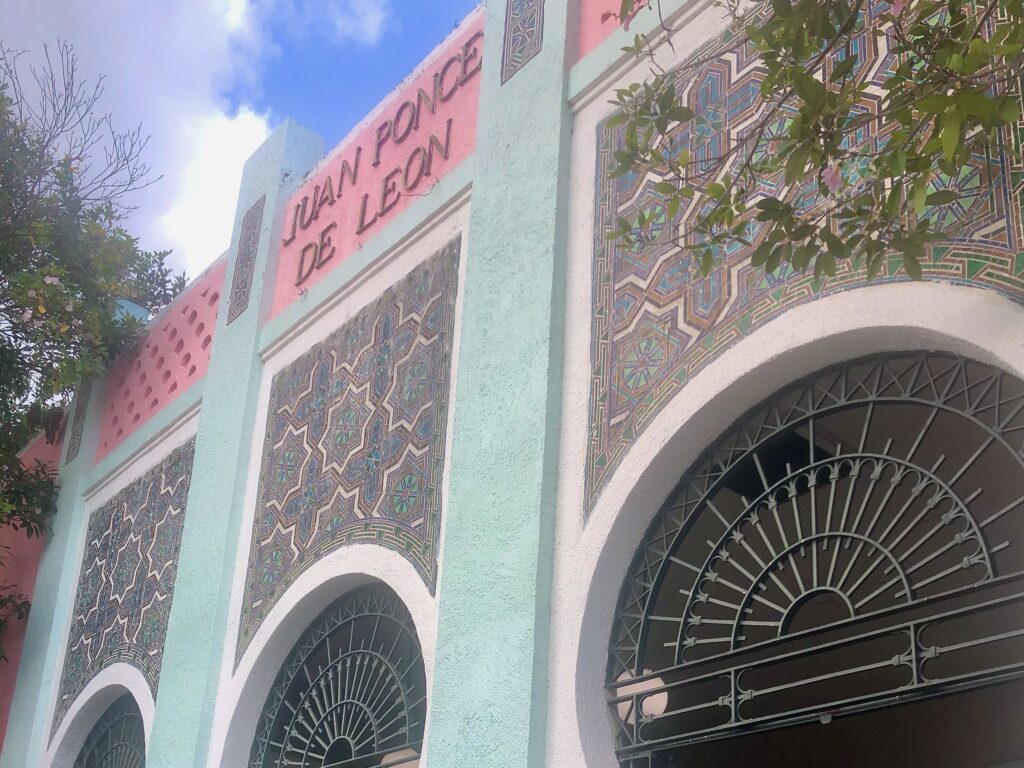
Despite its relatively small footprint compared to the main city market, its architectural elegance made it a standout project during the city’s early 20th-century modernization. The interior was originally designed with high ceilings and ventilation systems to maintain the hygiene standards required for a dedicated meat marketplace.
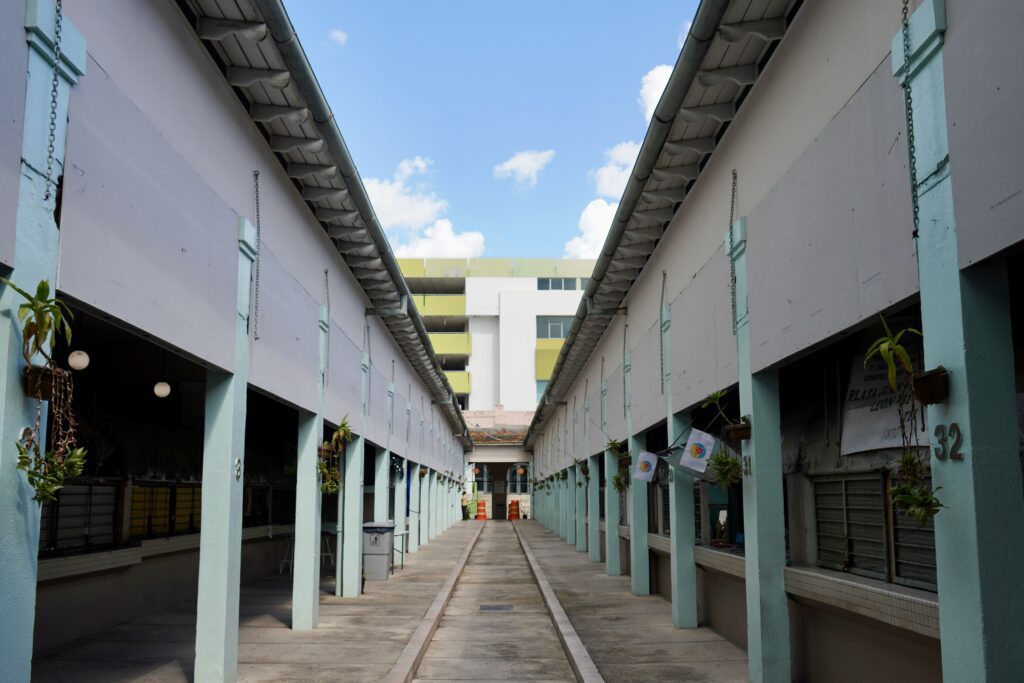
While it no longer functions as a wholesale meat market, the building was meticulously restored in the 1990s as part of the Ponce en Marcha initiative. Today, it serves as a multi-use cultural and commercial space, housing small businesses, government offices, and occasionally hosting artisanal fairs.
There were a few vendors selling local crafts when we were there.
The Home Depot
The only thing that makes a cruiser’s heart beat faster than a well-stocked grocery store is a large hardware store. The Home Depot? Yes, please!
It was just like the ones in the USA. We were like kids in a candy store.


Accommodations
A huge disclaimer here: We did not stay in any hotels in Ponce, Puerto Rico—we were staying on our boat. However, we walked through a few notable hotels.
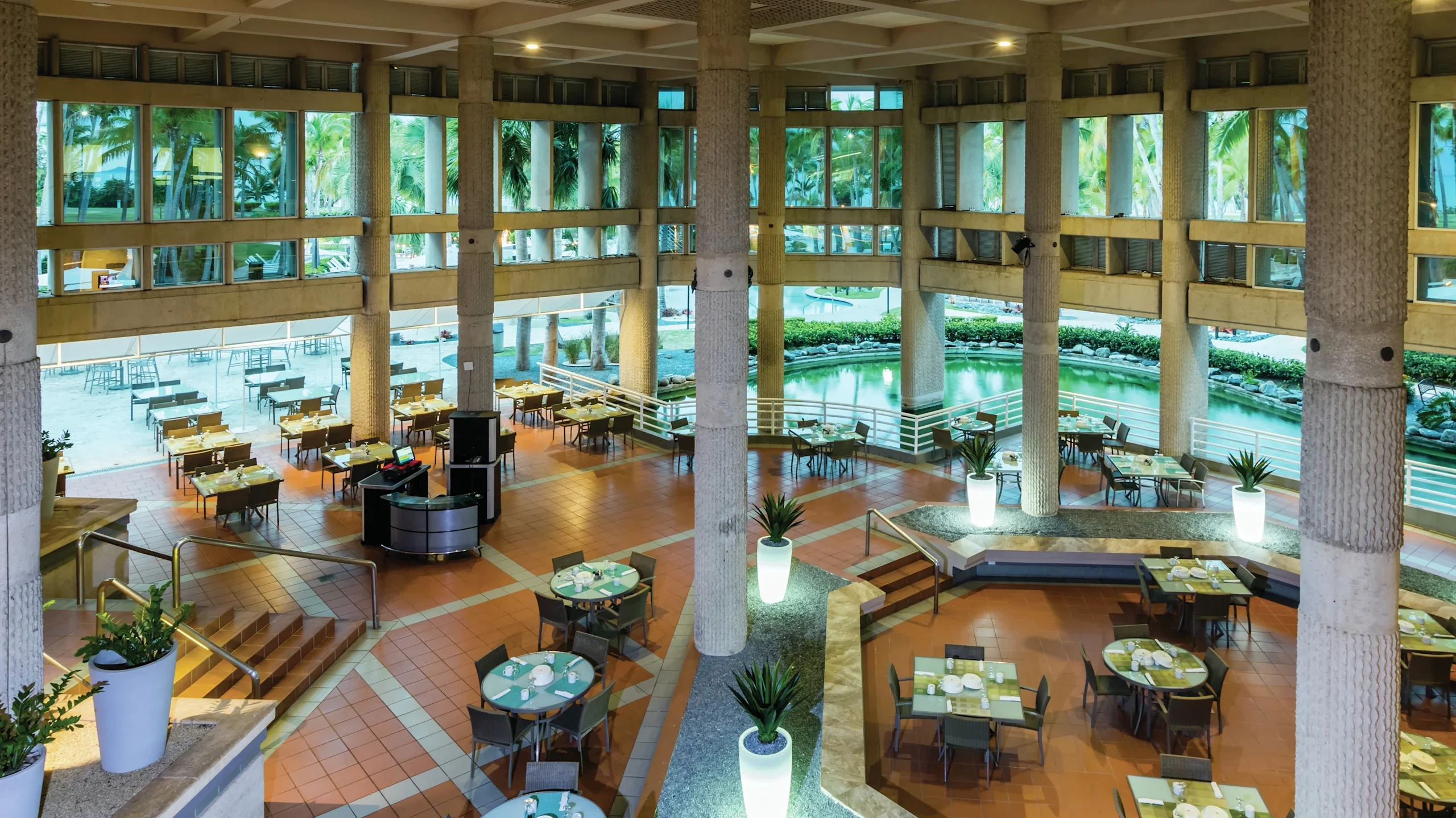
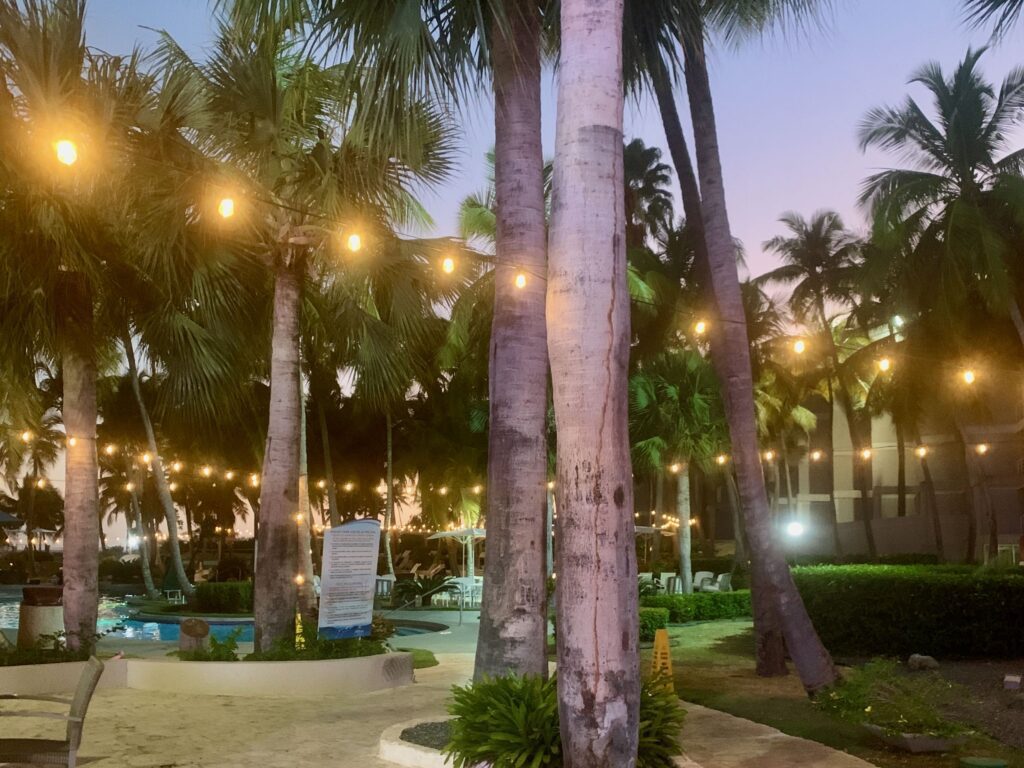
Hilton Ponce Golf & Casino Resort (4.5 stars)
We had dinner here and enjoyed it. It scores pretty high at 4.5 stars, but it is a bit secluded. Click here to view its location.
The Fox Hotel (4.0 stars)
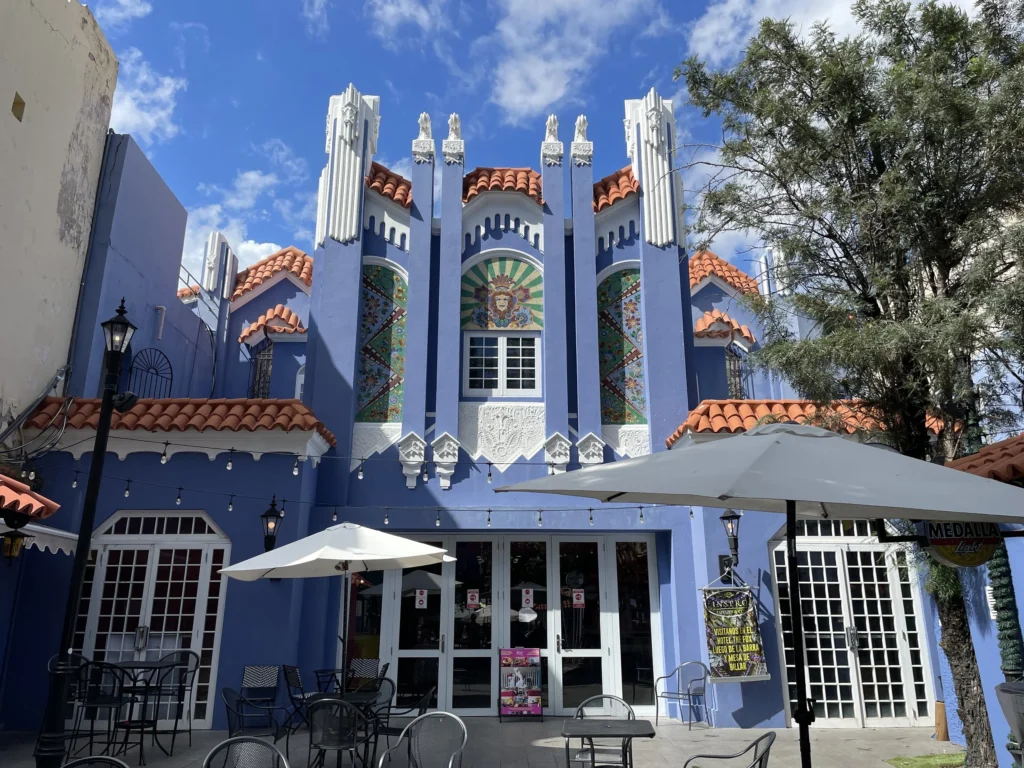
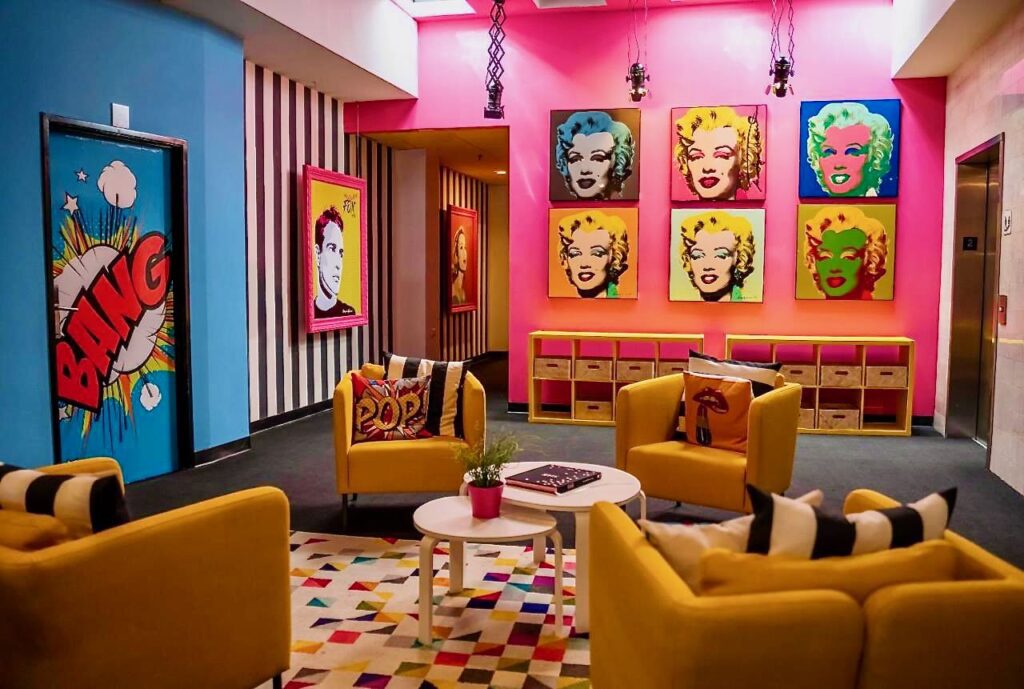
Originally opened in 1931 as an Art Deco movie theater, this historic building reopened in 2019 as the island’s first pop-art-themed hotel, the Fox Hotel. Located directly across from Plaza Las Delicias, the property features 30 rooms with vibrant, retro-inspired decor, four on-site restaurants, three bars, and a lively lobby with arcade games. The reviews for this hotel are slightly better than Meliá Century Hotel (4.0 stars), and the location is perfect if you want to be on the main square, Plaza Las Delicias, in downtown Ponce.
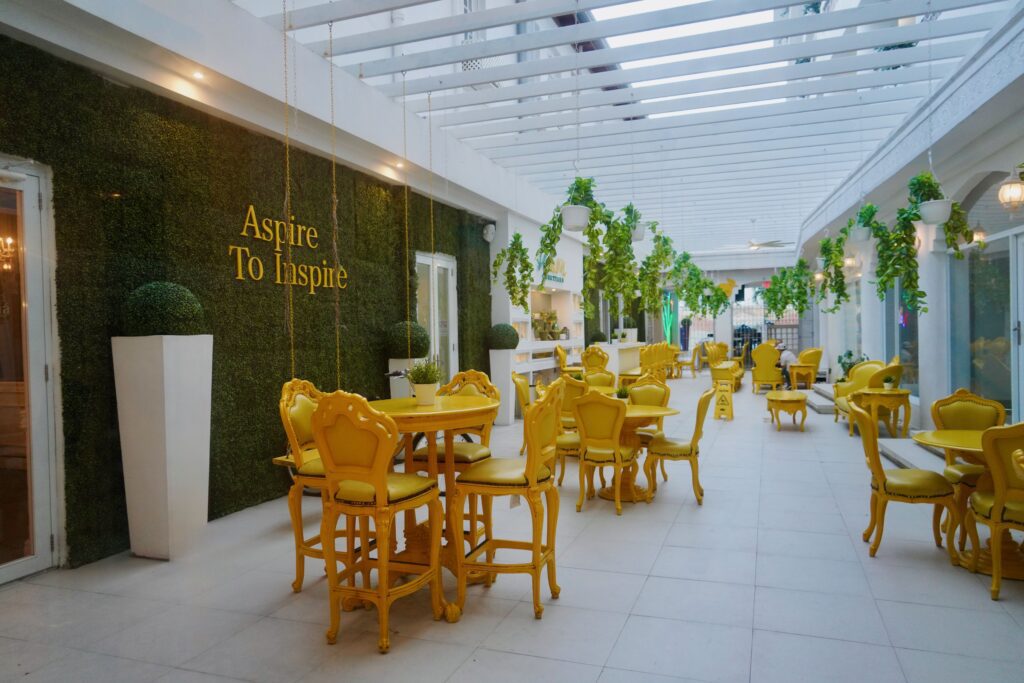
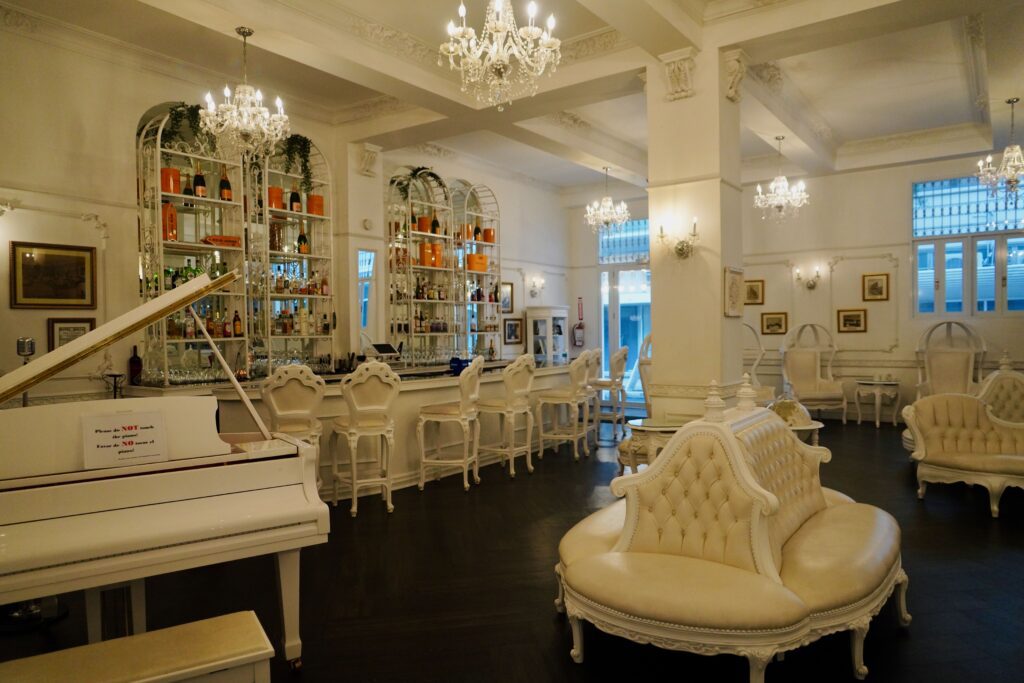
Meliá Century Hotel (3.5 stars)
What a shame. The reviews from hotel guests aren’t great (3.5 stars), but the public spaces sure are! It’s located near the main square, Plaza Las Delicias. Conceived in 1895, it is the oldest continuously operating hotel in Puerto Rico.
I really enjoyed its aesthetic.
Here’s a list of some other options:
- Holiday Inn Ponce & Tropical Casino By IHG (4.3 stars)
- Costa Bahia Hotel & Convention Center (4.4 stars)
- Aloft Ponce Hotel & Casino (4.2 stars)
- Spark by Hilton Ponce (4.2 stars)
- Hotel Nuevo Mejico (4.2 stars)
- Hotel El Eden (4.5 stars)
We stayed in the Ponce Harbor Northeast anchorage.
Getting There
Most people fly into San Juan and then drive down to Ponce. The primary route is Highway 52 (Autopista Luis A. Ferré), a well-maintained toll road that cuts through the island’s central mountain range, the Cordillera Central. The drive typically takes between 90 minutes and two hours, covering approximately 75 miles.
Tip: Make sure your rental car is equipped with an AutoExpreso tag for electronic tolling, as cash is not accepted at most plazas.
Mercedita International Airport (PSE) is also located just minutes from Ponce’s city center. It primarily handles direct flights from major U.S. hubs like Orlando and New York via JetBlue and Frontier Airlines. While San Juan’s Luis Muñoz Marín International (SJU) offers more international flights, arriving directly into Mercedita avoids the cross-island drive. Alternatively, públicos (shared passenger vans) offer a budget-friendly, albeit slower, local experience. Private shuttles and rideshare services like Uber also operate between the two cities, though costs can vary widely.
We sailed there on our catamaran.
Getting Around
The most reliable way to explore the city is by rental car, as parking is generally accessible outside of downtown. However, be aware that the narrow, one-way streets of the Zona Histórica can be congested.
Alternatively, Ponce offers public transportation via SITRAS (Sistema Integrado de Transportación del Sur). This bus system operates several color-coded routes that connect the urban center with outlying residential and commercial districts.
For shorter trips within the downtown area, Uber is well-established and often more affordable than traditional taxis, with average city rides costing around $10–$15. Taxis are also available, particularly at the Terminal de Carros Públicos Carlos Garay, which serves as a hub for both local and inter-city travel.
We took Ubers everywhere, and while we sometimes had to wait a bit for one to arrive, it always served us well.
Final Thoughts
Plaza Las Delicias serves as the heartbeat of Ponce, a sprawling center where Puerto Rican history and contemporary life intersect under the shade of ancient Indian laurel trees. Whether strolling with a scoop of King’s ice cream or taking part in an impromptu dance as the local orchestra plays, the people of Ponce have a deep-rooted love for their city and their culture, and they enjoy gathering to celebrate it.
Surrounding this lively scene is a concentration of historical architectural marvels that define the “Pearl of the South.” From the iconic red-and-black stripes of the Parque de Bombas to the elegant neoclassical facade of the Casa Alcaldía (City Hall), the plaza is an open-air museum. The towering Ponce Cathedral and the whimsical lions of the Fuente de los Leones provide a backdrop that feels frozen in time, yet is vibrantly alive. Ultimately, a trip to Ponce offers more than just sightseeing; it provides a profound connection to a community that honors its aristocratic past through the joyful, rhythmic energy of its present.
You can see a map of Ponce here.

Originally experienced in March of 2024; content refreshed in March of 2026.