
“Bula!”
The greeting reaches us before the person does. As we enter the village of Muana-i-cake, a middle-aged woman in a blue jumper steps out of her vale to meet us. Her house, like the others in the village, is made of corrugated iron, common in Fiji’s outer islands.
The woman grins and says her name is Bai (pronounced “Bye”).
Living at the edge of the village, she’s clearly done this plenty of times. She cheerfully asks where we’re from and whether we’ve come for sevusevu. After a bit of friendly banter, she leads us to a serious-looking man named Bale standing outside a blue house.
“Bula,” he says, then silently leads us toward the village center. After exchanging a few Fijian words with another man, Bale says we’ll be having sevusevu at the chief’s home.
The vale we arrive at is a yellow oval structure, and outside sits a crude, handmade concrete throne.
“What’s that for?” I ask.
“That’s where new chiefs get anointed,” Bale explains.
Fascinating, I muse. During all of our village visits, we’ve never seen this.
We slip off our shoes, enter the vale, and settle onto the floor, as we’ve done several times before. A large man with a serious expression emerges from behind a red floral curtain, and Bale introduces him as Chief Simon.
“Bula,” the chief says, joining our circle. “Thank you for coming for sevusevu.”
For context, sevusevu is the custom that opens every visit to a Fijian village. It involves offering the chief a bundle of kava to ask permission to be there. Some ceremonies are long and formal, rich with Fijian prayers. Here, though, it is quick and straightforward: we present our kava, and the chief accepts it immediately.
And just like that, we are no longer strangers who dropped anchor in the bay a few hours earlier. We are part of the 60-person community.
The chief tells us we’re the 176th yacht to visit this year—about four a week—which surprises me given how remote Fulaga is. He then explains that every guest is assigned a host family. Bale glances over and says his family will happily adopt us.
The chief asks us a few questions, but after several awkward moments of silence, we realize he isn’t one for small talk. Before we leave, he asks us to sign the yacht log and pay an anchorage fee, as is customary in Fiji’s outer islands. We happily comply.
On the way out, I compliment the chief on one of the room’s few pieces of furniture: a legless chair. It offers a chiefly stance within a culture that embraces sitting on the floor. He smiles and thanks me.
We thank the chief in return, then step back outside, ready to explore the village.
A Village of Artisans
It’s late in the day, but Bale asks if we would like to visit the woodcarving sheds. We’d learned that Fulaga is the backbone of Fiji’s woodcarving industry, so the invitation doesn’t surprise us. Most of what tourists find at the markets in Suva, Labasa, Lautoka, and Savusavu is made here.
At the first shed, we sit on a crude wooden bench as a man with silver hair and bloodshot eyes lays out several wooden items on a bedsheet on the ground in front of him.
He then demonstrates how to use the weapons and describes each piece. Fiji’s history of cannibalism is always a touchy subject. Some Fijians embrace it; others seem embarrassed.
“Pick one up,” he urges, gesturing to the bowls, animal figures, neck-breakers, and skull-crushers in front of us. We lift up a few bowls and admire the craftsmanship.
After watching the presentation, we say we will take photos of the items and discuss them over dinner.
Bale then takes us to the second wood carving shed, where we meet a woman named Qele. We browse a new selection of wood carvings and, once again, promise to consider them.
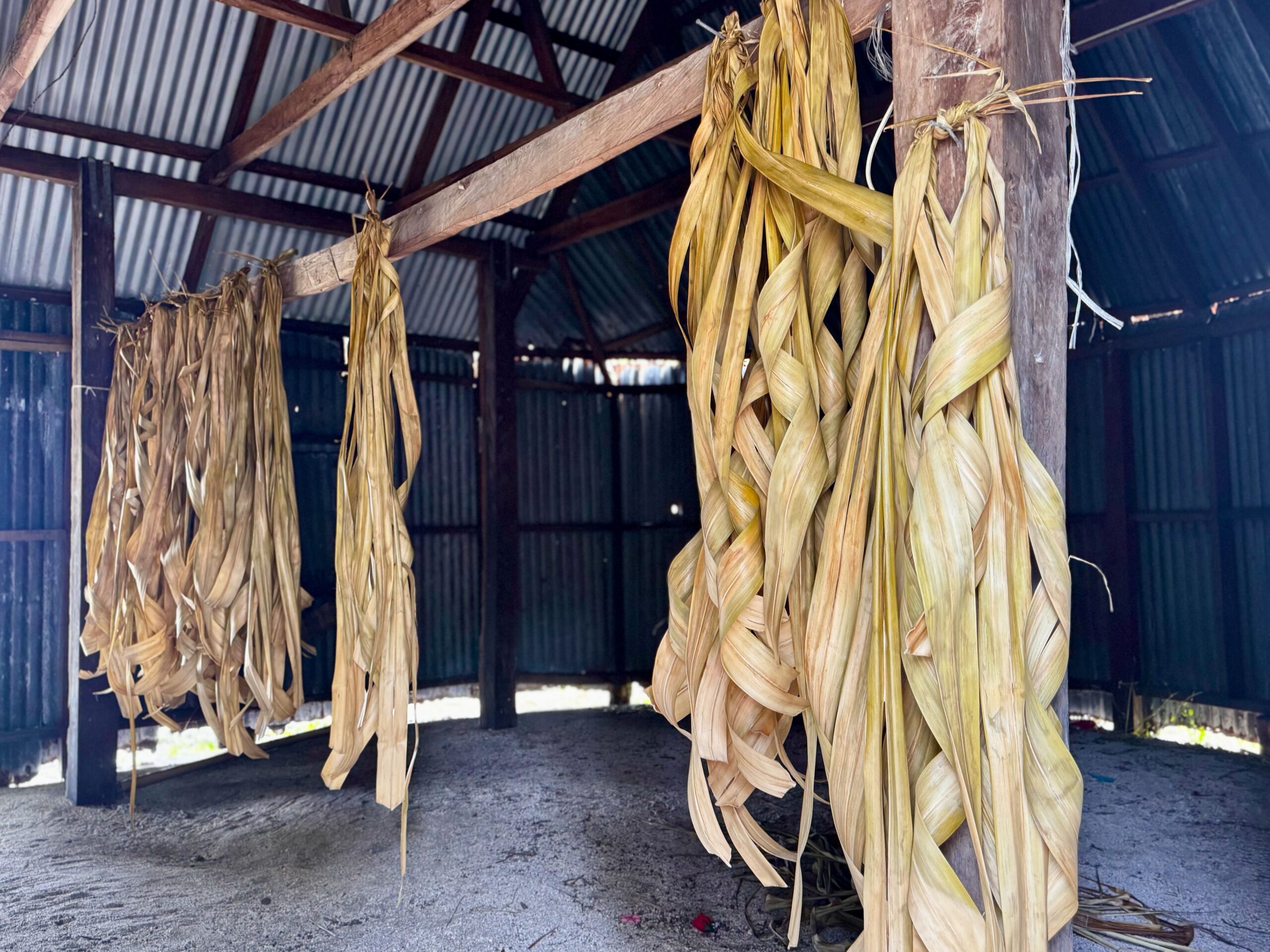
The women of the village are artisans in their own right: they are expert mat weavers.
With the sun setting, Bale suggests we return the next day for a more proper tour of the village, including its school. Before we leave, he takes us to his home to meet the rest of our host family: his wife, Lani, and three daughters, Lesu, Siana, and Emily. The welcome is gracious.
While there, we notice some rough beginnings of wooden bowls arranged neatly on the floor. Bale explains that, like many of the men in the village, he also does woodcarving.
After being added to the yacht log, we say we’ll return the next day to visit the school and the rest of the village. At the mention of a school visit, Lesu gasps, then squeals with delight.
We finally say goodbye and head down the path back to the dinghy beach. My husband, Roy, my brother-in-law, Steve, and I agree that the finished woodcarvings we saw looked far too perfect to have been handmade here.
“They’re probably from China,” Roy remarks.
Children, Bones, and Views
The next afternoon, we return to the village and go straight to the school, since it is already late. After meeting the headmaster, we visit the various classrooms—kindergarten, first and second, third and fourth, fifth and sixth, and seventh and eighth. The school serves 45 students, 17 of whom live in the other two Fulagan villages. The second two rooms we pass are filled with hammocks.
“What are those for?” I ask the teacher beside me.
“The boarding students from the two other villages sleep here during the week,” she explains. “Each of the parents takes turns staying here and preparing meals for them.”
As we enter each classroom, the students smile broadly. Some giggle.
After strolling around the school, we head to Bale’s home to ask for a tour of the Cave of Bones and the original village site.
“Yes, I can take you there,” he says, setting down the bowl he is carving and grabbing a pair of worn red tennis shoes. Before we head out, we notice how much progress he’s made on the bowls. They are stunning.
“Can you make a small one for me?” I ask. After discussing some options, he promises to have it ready the next day.
Bale then leads us up a slippery hill to the first stop, the cave. The path to the cave runs through a dense forest, and the small entrance is easy to miss. Inside sits a pile of bones.
“Who were these people?” I ask.
“We don’t know,” Bale answers. “Maybe Fijians, maybe Tongans. They’re very old—from the cannibal times.”
Cave burials were once widespread in Fiji. Sometimes villagers hid the bones to prevent enemy tribes from scavenging them. Other times, the bones belonged to unfortunate souls who were in the wrong place at the wrong time.
Our group kneels quietly in the dim cave, aware that we are visitors in a place with a history we don’t fully understand.
After inspecting some skulls, we return to the path and climb toward the old village site. At the top, there are no buildings, but we are rewarded with spectacular views of the bay. The climb is definitely worth it.
After soaking in the two sites, we descend the hill and return to Bale’s vale.
An Unexpected Treat
“Would you like to see some mat weaving?” Lani asks.
“Absolutely!” I exclaim.
We go next door, and there we find the village women sitting in a circle on the floor. Some are straightening leaves using seashells and large spoons; others are weaving.
Apparently, every Tuesday, the village women gather in the community center to weave. I suddenly feel lucky to be here on a Tuesday.
These gigantic mats (known in Fiji as ibe) are given as gifts to other villages and are sold at the main island markets alongside the wood carvings.
I watch, take pictures, and ask more questions than I probably should. Lani notices.
“Would you like me to make one for you?” she asks.
“A small one would be amazing!” I exclaim.
She starts weaving one that day, with promises to finish it overnight.
A Smaller Village and an Even Tinier Shop
Back at the family’s home, I ask, “Can we shop at the village store?”
At this, Lani scurries outside and looks down the center of the village to see if the shop is open.
“They’re closed,” she announces. She and Bale discuss the dilemma in Fijian; the shop’s hours seem irregular.
She clarifies, “They should reopen at 4 o’clock.”
We start wandering through the village, and we notice the students at the school lining up for dismissal. They wave enthusiastically and shout, “Bula!” as they pass.
As it turns out, we are headed the same way as they are—toward the other village, Muanaira—since we now have some time to kill. We walk alongside them and answer a stream of questions.
The students tell us that when the school runs out of food, they return home to their villages. They travel by boat from a mooring at the far end of Muanaira.
The second village is much like the first, just a bit smaller. We stroll around a bit and snap some photos before heading back.
Before returning to our boat, we stop at the village shop. As anticipated, it is tiny.
There, we browse the shelf-stable selection and buy a few staples. As we pay for our groceries, we’re amused to find that, instead of a cash register, a cookie tin holds the change. Every item is meticulously recorded in a ledger.
Reluctant Farewells
The next day, we return to collect my new mat and bowl.
As promised, they’re ready. And they’re lovely.
Lani presents the mat without fanfare, but I notice a red fringe—something I hadn’t even asked for. She seems to have noticed that I wore red every time I visited the village. It’s one of the most thoughtful gifts I’ve ever received.
Bale’s woodcarving is equally beautiful.
As we prepare to leave, we reluctantly say goodbye to our hosts. Some destinations are relatively easy to leave; this place isn’t one of them. You can’t truly understand its beauty and authenticity unless you experience it.
I dare say that’s why we travel.
Fulaga gets a lot of attention for the odd mushroom islands dotting its bays, and the wind sports its geography allows. While there, our crew wingfoils, kayaks, and explores the sand spits. But nothing compares to the raw cultural experience we receive.
There’s no regular transportation to the remote islands of Fulaga; only sailors and a few lucky cruisers choose to explore its shores. I’m grateful that we did.





Leave a Reply