
Some places remain secret simply because they are hard to reach, and Ogea is one of them. Nestled on the far southern edge of Fiji’s Lau Archipelago, the two raised coral islands of Ogea Levu and Ogea Driki sit closer to Tonga than to Suva.
The Lau Group is Fiji’s eastern frontier, a long scatter of islands extending toward Tonga, and for years cruising yachts largely avoided it. Even now, only a trickle of boats reach these islands each season. For us, that’s part of the appeal. The Lau is reputed to be Fiji as it once was, where village life still moves to the rhythm of the tides, church services, and the arrival of the supply ship.
Arriving at the Village
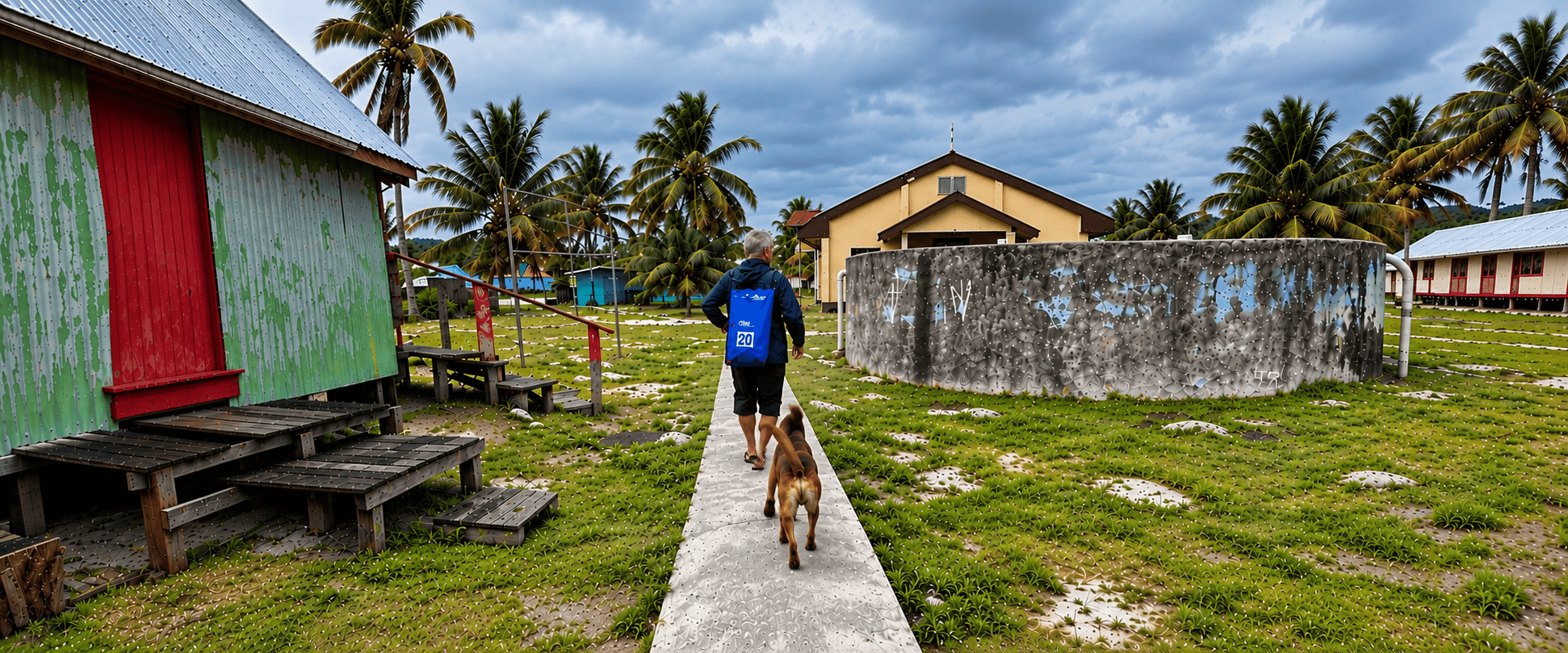
We come ashore at Ogea Levu Village as the tide rises. The village sits right at the water’s edge, as Fijian villages do, and the stillness is the first thing we notice. Houses are closed against the midday sun, paths empty, and I can’t help but wonder: Where is everyone? It feels almost eerie, as if the whole island pressed pause just before we arrived.

Ogea is about as remote as Fiji gets. Just 106 people live here, a supply ship calls once a month, and during our stay, we never spot a single cell phone. The village was once part of neighboring Vulaga (also known as Fulaga). When Vulaga’s leaders divided their villages into four, they moved only one here: Ogea’s. Now it stands alone, separated from the rest of Lau not just by open water, but in a sense, by history too. It feels a world apart.
Then, just a few steps in, a woman and her two young sons greet us. “I’m ‘Abbie,’” she says. I later ask her how this is spelled, and she says, “A-B-A.”
She offers to take us to the chief for a sevusevu, the traditional Fijian welcome.
Sevusevu is at the heart of any village visit in Fiji. Visitors don’t just wander in; they first present themselves to the chief with a gift of yaqona, the dried root of the kava plant. Once the gift is accepted, visitors become guests, free to walk, swim, and explore under the village’s care. In a place like Ogea, where outsiders arrive only by sea and only on occasion, it’s also how a community decides to open its doors.
Our welcome committee isn’t quite what we expect. Aba’s younger son has appointed himself head of security, armed with a toy rifle, scowling, taking aim, and picking us off one imaginary shot at a time. He keeps this up for much of our visit. We try offering a smile, but he’s not swayed. Aba’s puppy, Shadow, is far easier to please and almost knocks us over with his enthusiasm.

Aba issues a continuous stream of scolding, aimed at Shadow, the boys, or possibly both, her voice ringing across the silent village. It’s not the flower-garland arrival we’ve experienced elsewhere. It’s something very real, and quite interesting.
Sevusevu with Chief David
Chief David has been napping, but he quickly gathers his wife and three children and holds the ceremony on his front porch. Happily, he agrees when we ask to film it.
A sevusevu follows a familiar pattern, though no two are ever quite the same. Guests sit cross-legged, the kava is presented and accepted, someone welcomes everyone in Fijian, and the soft, hollow sound of cupped hands clapping punctuates key moments. Even if you understand only a few words, the meaning comes through: you’re being truly received.
Watch the ceremony with sound.
Partway through, Chief David playfully offers to send his “second wife,” Aba, home with us, prompting laughter and rapid Fijian banter that eludes us. Is it a joke? Mostly, we think. Whether Aba is his wife, a relative, or merely a neighbor at the receiving end of longstanding village humor remains opaque. We smile, laugh along, and decide that some mysteries are indeed better left unsolved.
By the end, the village formally welcomes us. My husband, Roy, signs the guest book and donates $50 FJD to the village’s flood-management project while two of Aba’s sons look on. When your home is only a few steps from the sea, high water isn’t an abstract concern. It’s a reality to plan around, cyclone season after cyclone season. A guest book in a village this remote is its own precious record of the few boats that venture this far, each name a visit from across a vast ocean.
Exploring the Village
We’re then free to explore. Two boats rest on the beach, and tide markers stand nearby, reminders that life here remains intertwined with the sea. A simple community outhouse and the Ogea Methodist Church sit a short walk away. In Fijian villages, the church is central to community life, with Sundays reserved for worship and rest.
Craftsmanship is apparent everywhere. Wood carvings adorn a banister, and a carved mask hangs on a door. Near a hammock, a dual-purpose carving spot, a pile of wood chips lies next to a kava bowl in progress.
The Lau Group is renowned throughout Fiji for its woodcarvers, and the tanoa, the wide, shallow bowl used to mix and serve kava, is one of their signature creations. Someone here, in the shade, is shaping a bowl that may one day sit at the center of a ceremony like ours.
The children are the highlight of the day. They gather around my phone, crowding the screen and happily posing for pictures.

Aba’s daughter, though, seems more interested in us than in the phone. She’s curious and full of questions, with a warmth that needs no translation. In a village that greeted us with closed doors and a scowling boy with a toy rifle, her openness feels like a gift.
She also seems older than her years. Around her, the afternoon is a whirl of scolding and squabbling, yet she moves through it all with a quiet composure. By the end of our visit, we’ve become friends.
Aba takes us to the village shop Sulu runs. Sulu, too, has been napping, and opens the doors with sleepy resignation. Our interaction is brief and businesslike. Maybe we’ve interrupted the best part of her afternoon, or perhaps it’s the language barrier. Nonetheless, we purchase eggs and cookies, which Aba carefully wraps herself. Out here, a shop like Sulu’s is a vital lifeline, and fresh eggs are a real treat for sailors.
Meanwhile, the children are being children. Brothers tease each other, the toy rifle reappears, and Shadow keeps up his energetic antics, reminding us that childhood looks similar everywhere, even on an island hundreds of miles from the nearest city.
A Ride Back to the Dinghy
Then, with the tide rising fast, it’s suddenly time to leave. Aba insists on ferrying us back to our dinghy, setting off a small adventure of its own. She searches for her husband, returns alone, peeks into a house for help, finding none, until her sister-in-law emerges, clearly not excited about the idea. Still, she climbs in, and together the two women steer the panga to our dinghy while Shadow paddles alongside. Roy keeps a protective arm around our new groceries.

It’s a short ride, yet it captures the day: a little hurried, a little puzzling, and, in its own way, kind. No one asked Aba to deliver us back to our dinghy. She simply decided it needed doing and did it.
We wave goodbye as the two women return to the village. This has been the most unusual village visit we’ve experienced, and easily one of the most memorable. Of all the faces in Ogea, I’ll remember Aba’s daughter most.
Making Sense of the Afternoon
Back on the boat, we replay the day. The empty paths, the scoldings, the boy with the rifle, the joke we never fully understood. Ogea doesn’t match the postcard version of a South Pacific welcome, and it’s tempting to compare the visit to our expectations.
Yet, we’re guests here, witnessing only a snapshot of village life. We don’t know what the past week has been like in Ogea, how boats have come and gone, or what it takes to sustain 106 people on such a remote island, with tides creeping higher each cyclone season. Or what it means for this community to stand alone, the only one of Vulaga’s villages moved across the water. A drowsy midday, sharp words for children, and banter we can’t decode are parts of everyday life in many places, including our own.
We arrive unannounced in the middle of a languid afternoon, and the village welcomes us. A chief awakens from his nap for sevusevu, a shopkeeper opens her doors, two women ensure our safe return with our eggs intact. And a curious, warm young girl makes us feel less like visitors and more like friends.
Not every village visit is a celebration. Some are simply ordinary days we happened to walk into, and those might teach us the most.

Leave a Reply