

We arrive at Susui carrying a debt. A few days ago, we spent more than a day in another village’s waters without doing a sevusevu, and it’s been nagging at me ever since.
We reach the island around two-thirty in the afternoon and drop anchor alongside four other boats. As anchorages go, it is not as spectacular as the Bay of Islands we just left. But of course, that’s relative. From the water we see a crescent of sand, a fringe of palms, and a smattering of rooftops tucked against the green. One village with sixty-seven people. No roads, no cars, no shops, no restaurants, no hotels. But they do have giant clams and ancient bones. We’re already itching to set foot on shore.
If we’re going to see anything beyond our boat, though, we should be invited.
Kava for the Chief
In Fiji, that invitation has a name: sevusevu. Before visitors walk through a village, swim over its reef, or set foot in its sacred places, they customarily present kava to the chief and ask permission. The chief accepts the gift, blesses it, and, in doing so, welcomes you. Out of respect, I don’t think we should treat it as merely a formality.
We have done our homework. Before arriving, we were in touch with the village headman, Jacob, and we expect to visit the village soon after we anchor. But almost as soon as we drop anchor, we watch the crews of the other four boats climb into their dinghies and head to the beach together. I can’t help wondering whether we are missing something.
We are, though not in the way I imagine. Later, the other sailors tell us what happened. The week before, the chief invited them to the village’s weekly church service and the villagers prepared a feast in their honor. The visitors never showed up. Now the chief had summoned them, and they were taken firmly to task. At least one villager was in tears. A feast in a village this remote is no small gift, and that’s what made the empty seats sting.
Jacob sends word that our sevusevu will be at 4:30, later than we expected. Now we understand why.
So before we head in, we get dressed for the occasion. Hats and sunglasses are off. I need to cover my shoulders and knees. Ideally, we’ll all wear a sulu, a skirt worn across Fiji by men and women alike. My husband, Roy, and my brother-in-law, Steve, who spend every day in shorts and T-shirts, stand in our salon tying theirs with the solemn concentration of boys trying a necktie for the first time. When they finish, they look proper.

We take the dinghy ashore clutching our bundle of kava, and Jacob meets us. He is warm and unhurried, and he leads us up to the home of the chief, a man named Philip.
The ceremony takes place inside, all of us seated cross-legged on a large woven mat. Jacob speaks on our behalf, presenting the kava and explaining who we are and why we have come. While he talks, my eyes wander around the colorful vale, the chief’s house. Bright floral cloth drapes the walls and rafters, and beneath a row of faded black-and-white photographs, small trophies stand neatly on a shelf. I wonder whose faces are in those pictures and what stories the trophies tell.
I also notice that Philip is wearing socks, an unusual sight on the islands. It strikes me as cozy. He listens, receives the bundle, and offers a long blessing in low, rhythmic Fijian.
At the end, he adds, “Just one thing: no fishing in the bay.”
Apart from that, I don’t understand many of the words, but I understand the moment—we are no longer strangers anchored in someone’s bay. We’re part of the community now.

Welcomed In
Jacob offers to show us around, and we follow him along the beach toward the heart of the village. His dog trots ahead of us, then behind us, then off toward the water for reasons it chooses not to share. It’s a golden retriever, a surprising purebred among the mixed-breed dogs we usually see on these islands.
Among the homes stands one traditional hut, built the way village houses have been built for generations. Inside, long strips of voivoi, or pandanus leaves, hang from the rafters to dry. Jacob offers to take our picture in front of it, but what I really want is a photo of him. He is the story here, not us.
Along the way, we notice red handprints painted on buildings and markers around the village. No one can quite tell us what they mean, and I hope to solve that mystery someday.

Jacob tells us he picked up fresh fruit and vegetables for us on his last shopping trip in Lomaloma, knowing we might want them. So we head to his vale to collect them and pay.
When we arrive, his wife, Bale, is sitting surrounded by voivoi, weaving a mat. Her fingers move quickly, folding and tucking the strips into a light-and-dark pattern.
Bale at work on a voivoi mat in her vale.
“How long has this mat taken to make?” I ask.
“Two weeks,” she replies.
She explains that she makes the darker strips by burying the leaves and baking them in the ground for three days.
The mat is exquisite, far too beautiful, in my opinion, to sit on. Bale does not share my opinion, though. She insists, so I sit, carefully, as though I might wear a hole in it just by looking. We chat, and she patiently shows me how they weave.
Everyone we pass that afternoon smiles or calls out a greeting.
“Bula!” they exclaim.
Through open doorways, I glimpse people stretched out on the floors of their vales, resting in the afternoon heat. Life here happens at mat level; furniture is the exception, not the rule.
Having performed sevusevu, we are free to roam, and the villagers treat us as though we belong. Before we part, Jacob makes plans with us for the next day. At our request, he will take us to Daliconi Village on Vanua Balavu to settle a debt, and afterward, back on Susui, to the “cave of bones.”
Settling a Debt
We had anchored in the Bay of Islands on Vanua Balavu, one of Fiji’s most beautiful anchorages, and for several reasons never presented sevusevu. Those waters belong to the village of Daliconi; we had kayaked and slept there, and our visit felt unfinished.
Jacob picks us up the next morning in his longboat. As we set off, I notice his anchor lying in the bow, a homemade contraption of rebar and pipe weighted with a block of concrete. Never has the phrase “necessity is the mother of invention” been truer. The solution is simple, yet brilliant.
The crossing to Lomaloma is too long and rough for our dinghy, but the longboat handles it well. Along the way, I notice a gold cross at Jacob’s neck, a quiet reminder of how deeply faith runs through these islands.
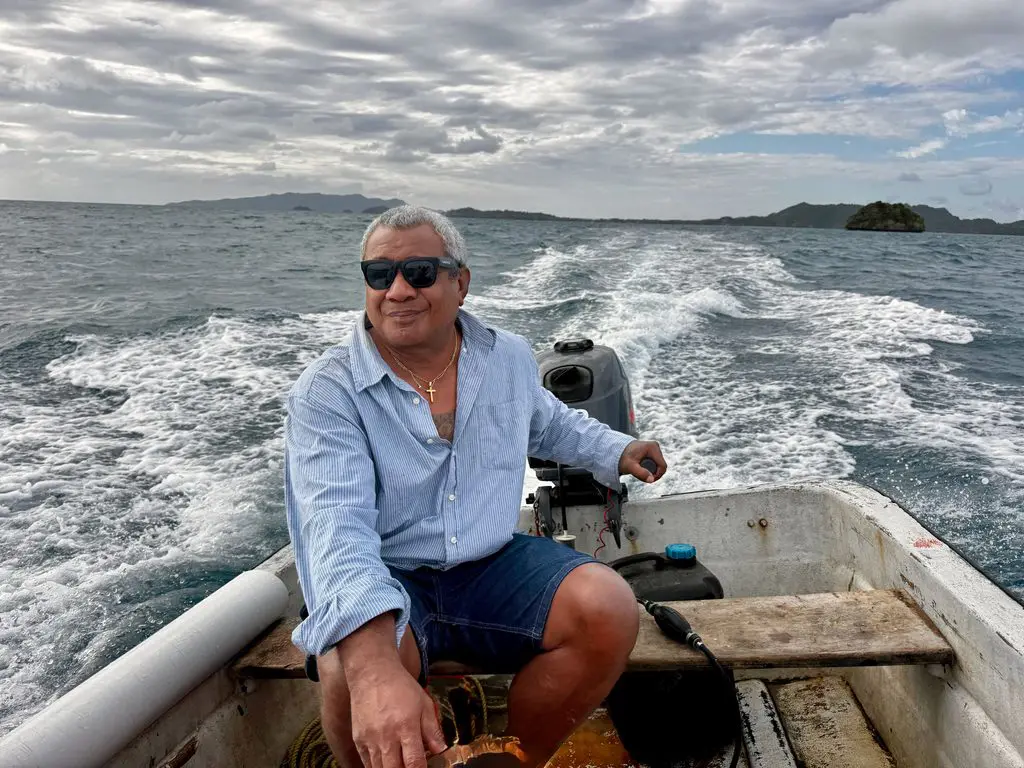
Jacob has arranged a truck to meet us, but unfortunately it never arrives.
“The truck went somewhere else,” he says, already scanning the road.
He spends most of an hour hunting for a replacement, and while we wait, I take in the town. Lomaloma is really two villages in one, and it is remarkably tidy. Two men pushing lawnmowers cross paths on a neat lawn. A few locals trade stories outside a shop. A parade of truck-buses rattles past, but Jacob says they cost too much for what we need.
In the end, the man behind the counter at one of the shops offers to drive us himself. We all breathe a sigh of relief, Jacob especially.
We bounce along the dirt road to Daliconi with our bundle of kava, dressed once again in our sulus.
At the chief’s house, we find him seated with his own headman: one chief, two headmen. Jacob speaks for us in Fijian, and when the chief answers, one phrase comes through again and again.
“You are forgiven,” he says. He smiles warmly.
I feel ashamed and grateful at the same time, and I’m very glad we came. When he finishes, the room seems to exhale.
The chief is kind and gracious, and Daliconi is beautiful, every bit as pristine as its neighbor.
We ride back to Lomaloma lighter than we came. Then Jacob takes us to the cave.
Where the Ancestors Rest
He explains the history as we walk. Before Christianity swept through the Lau Group in the mid-1800s, caves and crevices in the limestone served as burial places for chiefs, warriors, and members of high-ranking clans.
They deliberately placed the remains high and out of reach. If given the chance, rival tribes might desecrate the bones or carve them into tools, weapons, and fishhooks.
“Hiding the dead was a way of protecting them,” Jacob says.
The walk itself is lovely. We follow the beach for a while, and Jacob stops beneath an enormous dilo tree whose limbs sprawl so low and wide that Roy has to duck and weave his way underneath.

We then turn inland across a local farmer’s land, past yam, cassava, and pineapple plants that Jacob says will be ready to harvest in about three months. Near the cave entrance, a giant banyan rises, its hanging roots draped like curtains.
The path to the cave is not difficult, just slippery in spots. We squeeze through a rock crevice to enter. At the entrance, two skulls rest side by side on a ledge, as if they have been waiting for us. It is an abrupt welcome.
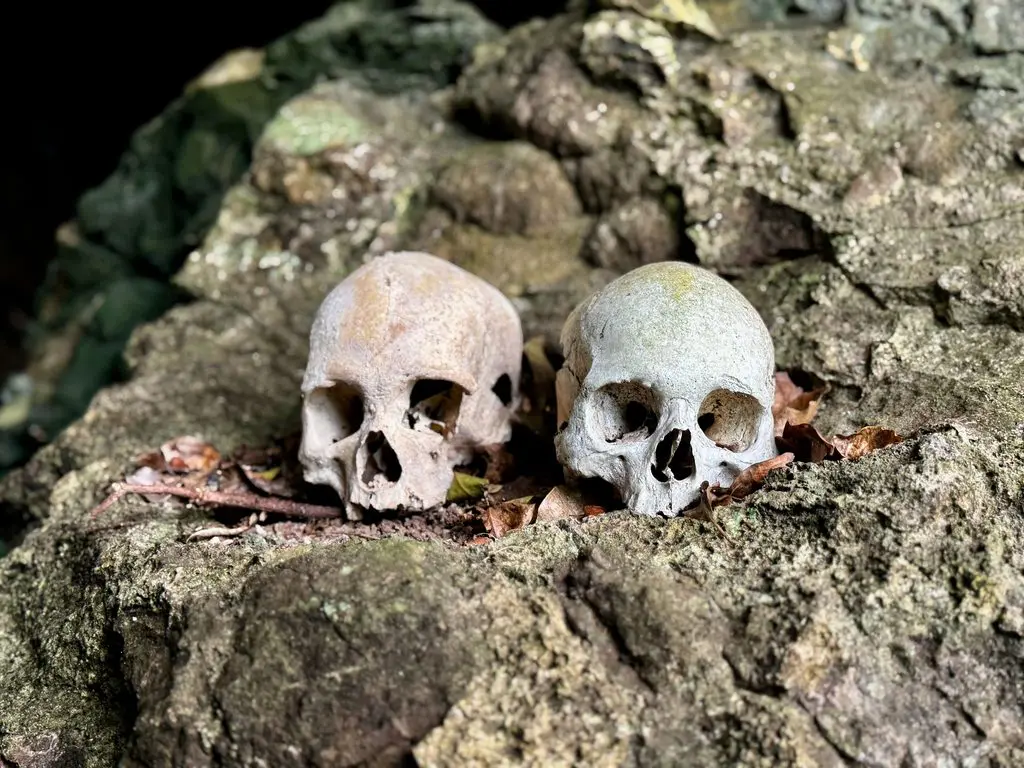
It is cool and dim inside. My eyes take a moment to adjust, and when they do, I see them: bones resting on ledges and in piles.
I’m not sure what I expected to feel. Not fear, exactly. Something closer to reverence. These are not exhibits behind glass. They are people—once very much alive with their own joys, aspirations, and fears—laid to rest in a place chosen to keep them safe. I’m curious about their stories.
Roy, a dentist, takes a special interest in the teeth, observing them but not touching them.
Steve and I stand back and let him look, while Jacob waits patiently. Nobody says much. When we finally step back into the sunlight, the sky and trees look brighter than before.
A Garden of Giant Clams
Susui has one more treasure to show us, and this one is underwater.
For years, the village has worked to restore its giant clam population. Today, more than forty healthy ones live on the reef in the bay in front of the village, in a range of ages and colors. According to Jacob, each takes about fifteen years to grow, which means the clams on that reef represent a commitment measured in decades.
He points us toward the general area, and the following morning, Roy and I take our dinghy to the spot and slide into the water.
“Just one thing: no fishing in the bay.”
Chief Philip
Finding them is harder than I expected. The reef is large, and the clams blend into it more than you’d think for creatures their size. I swim slow circles over the coral, peering down until I finally spot one, then another, then another, until I realize I’m floating over a garden of them.

Up close, they are extraordinary. Their mantles ripple with color in patterns that seem almost painted on. They sit half-open on the reef, unhurried and unbothered, as if they have all the time in the world. Which, in a sense, they do.
Part of me worries one will snap shut on me.
The reef around them is alive in a way I haven’t seen in a long time. Lokoloko ni Qio (blue linckia starfish) cling to the rocks. Sea cucumbers abound. This is clearly the chief’s doing: Philip has protected the bay from all forms of fishing. You don’t need to be a marine biologist to see the results. It looks the way a reef should.
Farewells
We hope to visit Wainiceva Beach as well, but we run out of time. That’s the thing about places like Susui. They don’t run on a schedule, and you can’t rush them. You come with kava in your hands and your knees covered, and you take what the island and its people give you in the time you have.
As we prepare to depart, we say goodbye to Jacob and his sweet wife, Bale. They are gracious hosts and have but one request.

“Do you have any old phones?” Jacob asks on Bale’s behalf.
Sadly, we don’t, but we make a note to bring some the next time we visit an island like this.
That evening, I sit in the cockpit and watch the light go soft over the village. Sixty-seven friendly people, one chief, a reef full of slow-growing clams, a cave full of carefully hidden ancestors, and a woman somewhere among the houses, weaving patterns out of leaves.
We came with kava in hand and asked permission. Susui gave us far more than we asked for.
Travel Notes
Getting here: There is a small airport in Lomaloma (Vanua Balavu) but not Susui.
Etiquette: Contact the headman in advance, and bring your own kava for sevusevu. You can’t buy it on Susui or Lomaloma.
Attire: Women must cover their knees and shoulders; men and women alike should wear sulus.
Transportation: To travel from village to village, you will need a ride in a longboat.
Shopping: Lomaloma has a few shops with basic items.
Gifts: Old phones are welcome.
Fishing: Not allowed in Susui’s bay.

Leave a Reply